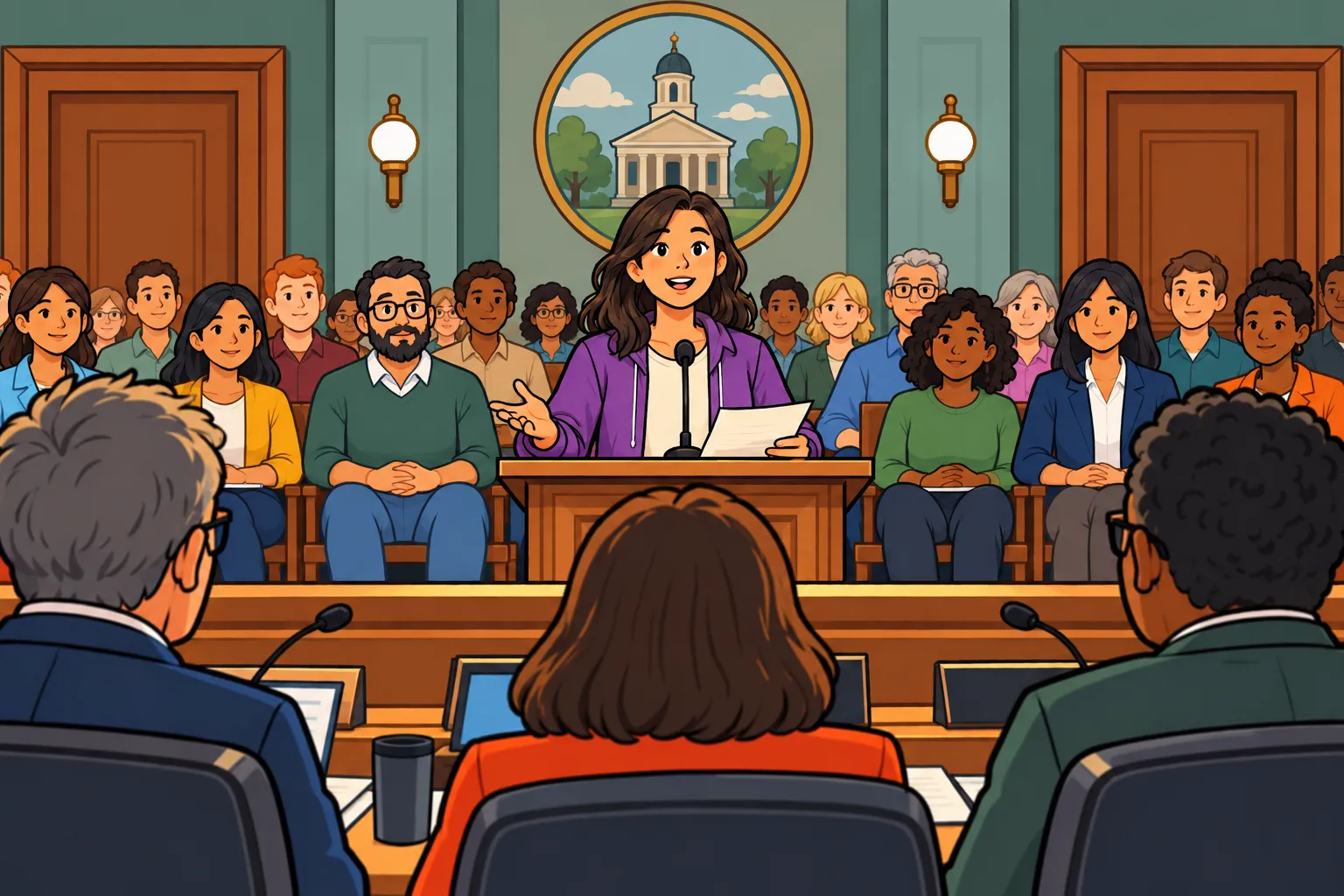
Civics is more than just memorizing facts about history and government; it teaches students how to actively navigate the present.
If you’re planning a curriculum for a middle or high schooler this year, you’ve probably stared at a list of social studies requirements and wondered where the overlap actually ends.
You see U.S. History, Government, Economics, and Civics. To a lot of parents and teachers, these just sound like four different ways to force a teenager to memorize the Bill of Rights.
It’s an honest misunderstanding, mostly because of how we were taught when we were young. A lot of us sat in a “civics” class that was really just a government class in disguise. We memorized the three branches, took a multiple-choice test on how a bill becomes a law, and moved on.
But true civics is fundamentally different from history, government, economics, and even citizenship. We need to understand that difference immediately, because the U.S. Chamber of Commerce Foundation has officially sounded the alarm, declaring that we are in the middle of a civics education crisis.
Here is the easiest way to separate these subjects, why your student needs far more than just facts to become a capable citizen, and why this is the exact class they need right now.
The Map, the Manual, the Fuel, and the Steering Wheel
To understand where civics fits, it helps to see what the other social studies subjects actually do.
History is the rear-view mirror and the map.
It tells us what happened, who did it, and how we arrived at the exact moment we are in right now. It is essential. You can’t understand where you are if you don’t know the road you took to get there.
Government is the owner’s manual.
It’s the schematic of the machine. A government class teaches a student that Congress has two chambers, that the President has veto power, and that the Supreme Court can strike down laws. It is the study of the structure.

Economics is the fuel.
It explains how money, resources, and trade move through the system and affect the people living inside it.
Citizenship is the legal status.
It is the passport. You are born with it, or you earn it through a legal process. It is a noun.

Civics is the steering wheel.
Civics is an action verb. It is the study of how a regular person actually gets into the car, turns the key, and drives. It is not about memorizing the machine; it’s about operating it. It’s the bridge between the past (history) and the here and now.
To see this in practice, look at how these subjects cover the exact same historical event: The Civil Rights Movement.
- History teaches the timeline: the Montgomery Bus Boycott, the March on Washington, the tragic assassinations, and the eventual legislation.
- Government teaches the mechanics: how the Civil Rights Act of 1964 was debated in Congress, filibustered, signed by the President, and later upheld by the Supreme Court.
- Economics examines the financial levers: how targeted boycotts crippled local transit revenues and forced economic change when moral arguments stalled.
- Civics teaches the student how to look at their own community today. It asks: How do you identify an injustice in the here and now? How do you organize a town hall? How do you speak to a city council? How do you build a coalition of people who might not look like you or agree with you on every other issue?
Civics connects the past to the present. It teaches students exactly why we need to study and learn from history in the first place – so we can pick up those same tools and use them today.
We want citizens, not fact machines
When we only teach history and government, we run the risk of turning students into fact machines. They can tell you exactly what year the 19th Amendment was ratified, but they have no idea how to pull up a local sample ballot and research the people running for school board.
The danger is that if we treat civics like a trivia test, we fail. The Annenberg Public Policy Center recently released data showing that Americans’ civics knowledge is actively dropping when it comes to the First Amendment and the branches of government. A shocking number of citizens cannot name the basic freedoms guaranteed by the First Amendment or correctly identify the three branches of the federal government.
When citizens don’t know their rights, they can’t defend them. But memorizing a list isn’t the cure.
Civics teaches students to be citizens: engaged, active participants in our government and democracy. Critical thinking is the core of this. An engaged citizen knows that a city council zoning decision might affect their daily life more than a presidential debate does. They understand how to move past complaining on the internet and actually organize, advocate, and vote in a way that shifts the needle.
They understand that their voices genuinely matter.
The lost art of the listening ear
If there is one thing teenagers absorb from watching the adults around them, it’s that political engagement means being loud. The angriest voice gets the most screen time. Polarization has convinced an entire generation that politics is a team sport where the only goal is to completely destroy the other side.
A good civics education actively fights this. Yes, civics teaches a student why their voice matters. But crucially, it also teaches them why their listening ears matter just as much.
Research heavily supports this. A study hosted by the American Political Science Association highlights that building political knowledge is directly tied to the development of civic dispositions and skills. Students who receive quality civics instruction are remarkably better at understanding other people’s points of view, even if they fundamentally disagree with them.
Critical thinking isn’t just about tearing down someone else’s argument. It is the ability to look at information impartially, recognize your own biases, and listen to a neighbor who votes differently than you do without writing them off as a threat.
A functioning democracy requires compromise. It requires neighbors to figure out how to share a town, a budget, and a country even when their worldviews clash. When we teach kids how to keep a level head in spite of extreme political polarization, we are handing them a superpower. We are teaching them that it is possible to hold strong convictions and still treat the person sitting across the table with basic human dignity.
The surprising side effect: It’s better for business
There is a final, highly practical reason why civics is distinct from history or government – and why it is so essential for the future. The skills students learn in a high-quality civics curriculum don’t just stay in the voting booth. They carry directly over into the workplace.
The U.S. Chamber of Commerce Foundation recently launched a report in the Harvard Business Review detailing the explicit “business case for civics.” The findings were clear: students who know civics are actually better for business.
Why? Because a student who has been taught how to navigate a disagreement, listen to opposing viewpoints impartially, and collaborate on a shared goal makes a phenomenal employee. The exact same civic skills required to run a local community board are the skills required to run a successful boardroom. A high-quality civics education doesn’t just produce better voters; it produces better leaders, better innovators, and better colleagues.
How The Civics Club builds active citizens
This is exactly why we built The Civics Club. We wanted to move past the dry, multiple-choice worksheets and give middle and high schoolers a curriculum that actually prepares them to step into the public square.
Students in The Civics Club certainly learn the fundamentals of how government works. But more importantly, they learn how citizens can engage directly with that government. They learn how to read a news source and figure out its slant. They practice holding hard conversations, evaluating information impartially, and understanding the real-world impact of local versus federal decisions.
Most importantly, they learn how to keep a level head in spite of political polarization. They learn how to consider different points of view critically and fairly, engaging not just in history, but in the messy, vital work of the here and now.
A country full of citizens who only know history will just watch it repeat itself. A country full of citizens who know civics will steer it somewhere better.
Whether you are running a co-op, teaching a classroom, or working with your own kids at the kitchen table, this is the exact skill set they are going to need to navigate the world they are inheriting.
Ready to teach civics as something students actually do?
Help students move beyond memorizing how government works. Give them the skills to evaluate information, understand different points of view, and participate thoughtfully in civic life.
The Civics Club provides ready-to-teach, non-partisan civics curriculum for classrooms, co-ops, and homeschool families.