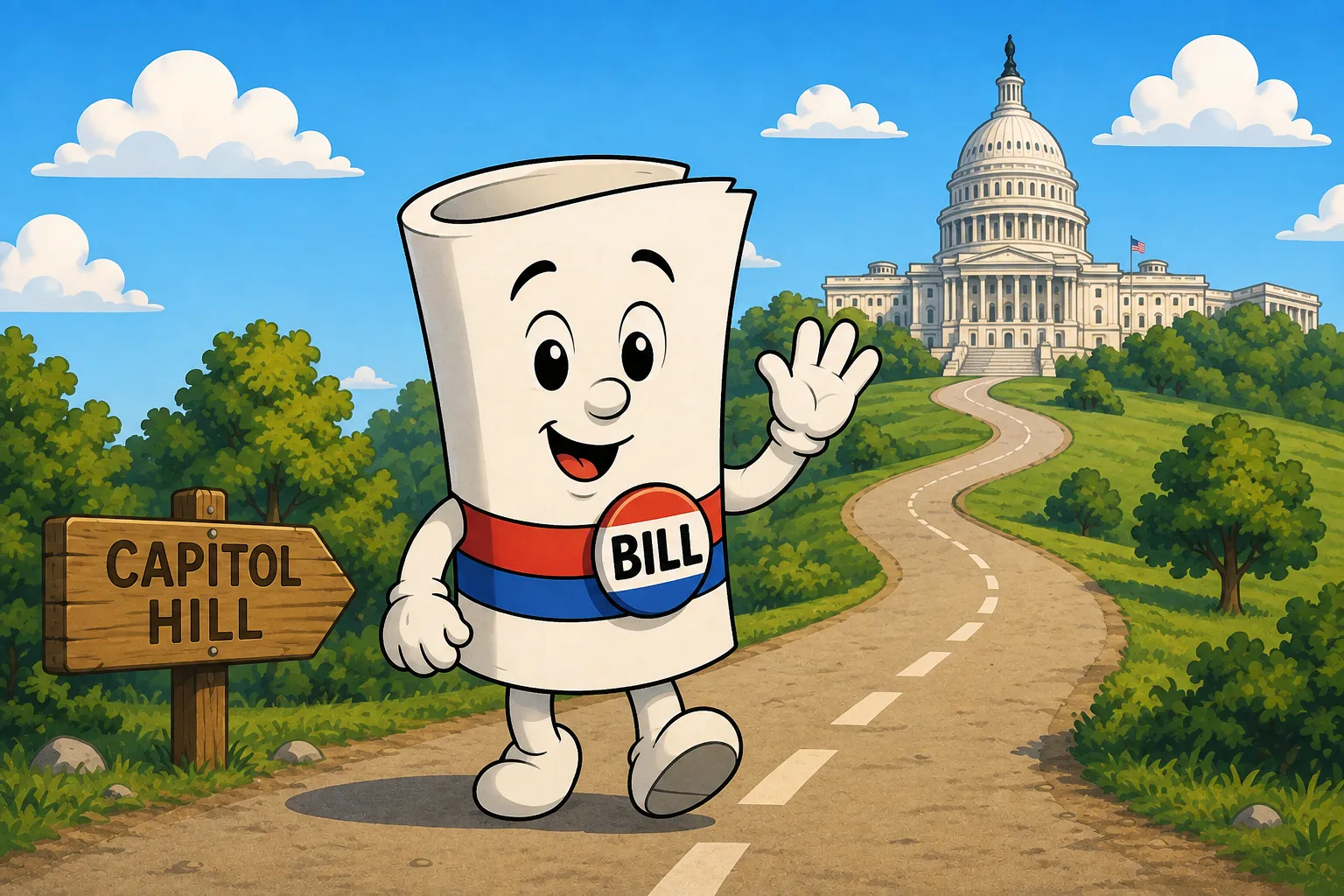
A clear, classroom-ready walkthrough of how a bill becomes a law.
Ask a room of middle schoolers where laws come from, and you’ll hear some version of “the government makes them.” True enough. But it leaves out the best part of the story: a huge number of laws start as an idea from a regular person. A parent worried about a dangerous intersection. A student who noticed something unfair at school. A neighbor who thought there had to be a better way.
Someone like you. Someone like your kids.
That’s the part that makes civics click for young people. Laws aren’t handed down from a mountaintop. They’re built, step by step, out of ideas — and citizens are where a lot of those ideas begin. Once a student understands that, “how a bill becomes a law” stops being a worksheet and starts being a door.
Here’s the whole journey, laid out plainly enough to teach tomorrow.
It starts with an idea (yes, even yours)
Every law begins as a proposal called a bill. And a bill has to start somewhere.
Members of Congress write bills. So do their staffs. But the spark behind a bill often comes from outside the Capitol entirely — from people living regular lives who spot a problem worth fixing. A citizen writes or calls their representative. A group of neighbors shows up to a town meeting. A class sends letters about an issue they care about. Lawmakers pay attention to that, because those ideas come from the people they were elected to serve.
Kids find this genuinely surprising. Walk them through a real example: students have helped pass state laws naming an official state dinosaur, requiring recycling in schools, and protecting kids online. Someone their age had an idea, and it turned into law. That’s not a fairy tale. It happens.
So the first step isn’t “Congress decides.” The first step is someone cares about something.
Step 1: A member of Congress introduces the bill
An idea can’t become law on its own. It needs a sponsor — a Senator or a Representative who agrees to introduce it.
Once a member introduces the bill, it gets a number (you’ve probably seen labels like “H.R. 40” or “S. 12” — “H.R.” for the House of Representatives, “S.” for the Senate). Now it’s official, on the record, and ready to be studied.
Step 2: The bill goes to committee
This is the step most people forget, and it’s where a lot of the real work happens.
Congress is too big to debate every single bill as one giant group, so it splits the work among committees — smaller teams that each focus on a topic, like agriculture, education, or the armed forces. The bill goes to the committee that fits its subject.
The committee is where a bill gets examined closely. Members study it, ask questions, and hold hearings where experts and everyday people testify. The committee can change the bill, approve it, or set it aside so it goes no further. Most bills actually stop right here — which is a useful reality check for students. Getting an idea introduced is a real achievement, but the committee is a serious test.
Step 3: Debate and vote in the first chamber
If the committee approves the bill, it moves to the full chamber it started in — either the House or the Senate.
Now the whole group debates it. Members argue for it, argue against it, and often propose changes called amendments. This is democracy out loud: people who represent different parts of the country, with different priorities, working out what they can agree on.
Then they vote. If a majority says yes, the bill passes that chamber — but it’s only halfway home.
Step 4: It does the whole thing again in the other chamber
Here’s the part that surprises students most: a bill has to pass both the House and the Senate.
So after it clears the first chamber, it heads to the second one and goes through the same gauntlet — committee, debate, amendments, vote. Congress is built this way on purpose. Two chambers checking each other means a bill has to earn broad support, not just squeak through one room on a good day.
Sometimes the two chambers pass slightly different versions of the same bill. When that happens, members from both sides meet to work out one combined version everyone can agree on. Then both chambers vote on that final text.
Step 5: The bill goes to the President
Once both the House and the Senate pass the same version, the bill lands on the President’s desk. Now one of a few things happens:
- The President signs it. The bill becomes a law.
- The President does nothing for 10 days while Congress is in session. It becomes law anyway.
- The President vetoes it — officially refuses to sign. The bill is sent back to Congress.
A veto isn’t always the end, though, which brings us to the last check in the system.
Step 6: Congress can override a veto
If the President vetoes a bill, Congress gets one more shot. If two-thirds of both the House and the Senate vote for it again, the bill becomes law even without the President’s signature. That’s called overriding a veto.
It’s rare, because getting two-thirds of both chambers to agree is hard. But it’s there for a reason: no single person, not even the President, gets the final word all by themselves. Power is shared and checked at every step. Point that out to students — it’s the whole design of the system in one move.
Bring in the classic video
If you want the steps to stick, cue up the song that’s taught this to American kids for nearly fifty years: “I’m Just a Bill,” from Schoolhouse Rock. It’s the cartoon of a hopeful little bill sitting on the Capitol steps, explaining his journey while he waits to find out if he’ll make it.
It’s short, it’s catchy, and it nails the emotional truth of the process — the waiting, the long odds, the “I hope and I pray that I will, but today I am still just a bill.” Play it once for fun, then play it again and have students raise a hand each time the bill hits a step you just taught: introduced, committee, votes in both chambers, the President’s signature. Suddenly a 1970s cartoon becomes a review sheet.
One honest note for older students: the song simplifies things, and real bills take more twists than a three-minute cartoon can show. That’s a feature, not a bug. Ask them: what did the song leave out? You’ll get a better discussion than any quiz could.
Why this matters more than a worksheet
The reason to teach how a bill becomes a law isn’t so kids can label a flowchart. It’s so they understand something bigger: the system has a door, and they’re allowed to walk through it.
When a young person really gets that a law can start with a phone call, a letter, or a few neighbors who won’t let an issue go, civics stops feeling like something that happens to them. It becomes something they can do. That’s the shift from watching democracy to being part of it — and it tends to stick for life.
Teach the whole story with The Civics Club
At The Civics Club, this is exactly the kind of lesson we build for middle and high schoolers — clear, engaging, and non-partisan. Our curriculum walks students through how government actually works and, just as important, how they fit into it. No dry memorization, no political spin. Just the tools young citizens need to understand their country and their own power within it.
Our lessons are ready to teach whether you’re running a classroom, a co-op, or a kitchen table. Everything is laid out step by step, with discussion prompts, activities, and real examples that make ideas like this one land.
Ready to make civics come alive for your students? Explore The Civics Club curriculum today.