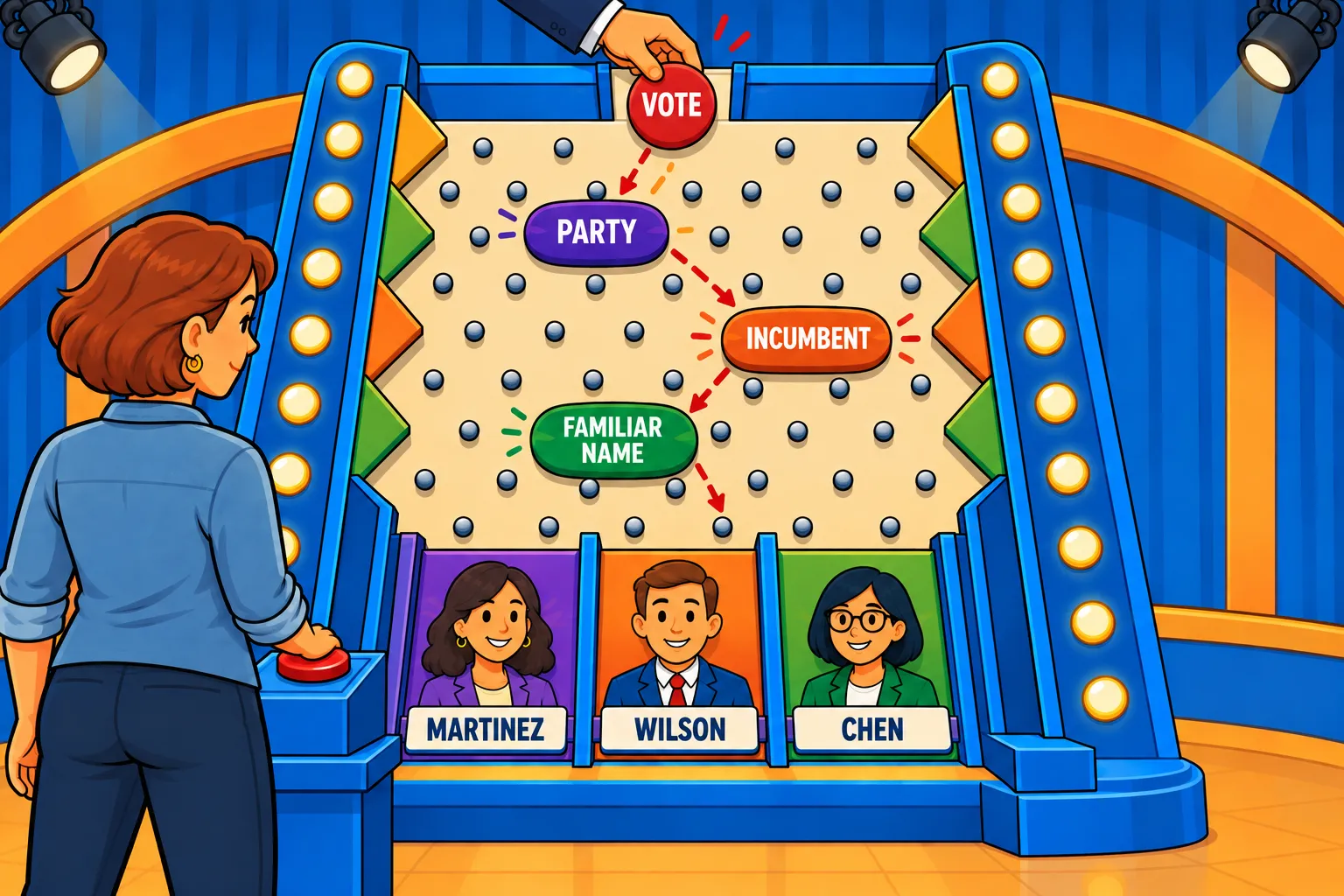
Voters use shortcuts like party labels and name recognition to make decisions. Here’s how to teach students when those shortcuts help — and when to look deeper.
Picture a voter standing in the booth. They’ve got a ballot in front of them, and near the top are the races they came for — president, governor, maybe a senator. They know those names. They have opinions.
Then they scroll down. County commissioner. School board. A judge or two. Three names they’ve never heard, running for a job they couldn’t quite describe. The line is long. Lunch break is almost over. So they do what most people do: they pick the name that looks familiar, or they vote the party they always vote, and they move on.
That’s not a lazy voter. That’s a normal one. And it’s exactly why civics belongs in your classroom or at your kitchen table — not as a lecture on how government should work, but as an honest look at how people actually decide.
What the research actually says
This isn’t opinion. Political scientists have studied voter behavior for decades, and the findings are remarkably consistent.
A 2013–14 review prepared for Clark County, Washington, pulled the research together and named three clear patterns in local elections:
1
Turnout drops. Voter turnout runs about 10 percent lower in nonpartisan elections — races where no party label appears on the ballot — than in partisan ones.
2
Party matters less when it’s missing. When party affiliation isn’t printed next to a candidate’s name, voters rely less on party when making their choice.
3
Incumbency matters more. With no party label to lean on, voters tend to rely more heavily on whether a candidate already holds office.
The same research made a bigger point that every student should sit with:
In the absence of a widespread crisis or similar galvanizing event, voters tend to be poorly informed and only moderately interested in local politics.
Read that again. Unless something big and alarming is happening, most people don’t do much homework before an election — especially a local one. They’re busy. The stakes feel small. So to make a decision, they reach for whatever is fastest and costs them nothing: voting the same party they always vote, or picking the one name they already know.
Researchers have a term for these mental time-savers. They’re called informational shortcuts — or cues.
What is an informational shortcut?
A shortcut is a piece of information that stands in for a lot of other information you didn’t have time to gather.
Your students use them every day. They pick a restaurant because the parking lot is full — “full lot” is a shortcut for “the food must be good.” They trust a video because it has a million views. They buy the phone their friends have. None of these are the same as real research, but they’re fast, and most of the time they’re good enough.
In the voting booth, a party label is the most powerful shortcut of all. See a “D” or an “R” next to a name and — without knowing a single thing about that specific person — you suddenly have a rough guess about where they stand on taxes, schools, and a dozen other issues. That’s a lot of information packed into one letter.
Name recognition is a shortcut too. “I’ve heard of her” quietly becomes “she must be qualified.” But those two things aren’t the same, and that gap is where things get interesting.
The question worth arguing about
Here’s the debate to put in front of your students, because there’s no clean answer — and that’s the point.
The case that shortcuts hurt:
When people vote purely on party or on a familiar name, they may never learn what a specific candidate actually believes or has done. The research backs this up: nonpartisan races tend to help incumbents, because when voters can’t lean on a party label, they fall back on name familiarity — and the person already in office is usually the most familiar name on the ballot. So the “easy” pick isn’t always the best pick. Sometimes it just rewards whoever got their name out first.
There’s another cost. When party loyalty becomes the only thing driving a decision, one review compared it to rooting for a sports team — an attachment so strong it can shut down a voter’s willingness to honestly weigh candidates from the “other” side. A shortcut that started as a time-saver can quietly become a blindfold.
The case that shortcuts help:
But party labels aren’t nothing. They carry real, useful information. A label can help a busy voter make a reasonable choice quickly, even without hours of research. When researchers Squire and Smith ran experiments in the 1980s, they found the share of voters with no opinion about candidates dropped sharply once voters were told the candidates’ parties. People also felt more confident in their choices. Take the label away and many voters end up guessing — or not voting on that race at all.
So which is it? Do shortcuts lead us to the best candidate, or just the easiest one to pick?
The honest answer: sometimes they’re the same, and sometimes they’re not — and a good citizen learns to tell the difference.
That’s the whole ballgame. A shortcut isn’t automatically wrong. Party can be a genuinely helpful clue about how a candidate might govern. The danger isn’t using the shortcut. The danger is never checking whether the shortcut is right this time.
How to teach this (without telling kids how to vote)
This topic is a gift for the classroom or homeschool table because it builds critical thinking without pushing anyone toward a party. You’re not teaching students what to think about candidates. You’re teaching them how to think about their own decisions. Here are a few ways in.
1.
Run a “no labels” mock election. Give students three short candidate profiles — real positions, no party names attached. Have them pick a winner and explain why. Then reveal the parties and ask: did anyone want to change their vote? Why? This makes the power of a single label impossible to miss.
2.
Hunt for shortcuts in daily life. For a week, have students jot down every time they chose something based on a shortcut — a video, a snack, a game, a person. Then ask: which shortcuts served you well? Which ones let you down? The voting connection writes itself.
3.
Practice going one layer deeper. Pick one local race in your area — school board is perfect, because it directly affects them. Have students find one real fact about each candidate beyond the name and the party. Just one. They’ll feel firsthand how little effort it takes to move from “the easy pick” to “an informed pick.”
4.
Debate the big question head-on. Split the group. One side argues party labels help voters decide well. The other argues they get in the way. Make them use the research, not just their gut. The goal isn’t a winner — it’s students who can hold two true things at once.
Why this matters more than a test grade
Most of us were never taught this. We learned the three branches of government and how a bill becomes a law, and then we were handed a ballot and expected to figure out the rest.
The students in front of you don’t have to start from there. When a young person understands that their brain reaches for shortcuts — and that shortcuts are useful right up until the moment they aren’t — they gain something a memorized fact can’t give them: the habit of pausing to ask, “Am I choosing the best option here, or just the easiest one?”
That single question is the heart of good citizenship. It also happens to be the heart of good thinking about everything else — the news they scroll, the ads they see, the crowd they follow.
That’s exactly what our Civics Club curriculum is built to do. It’s designed for middle and high schoolers, it’s genuinely non-partisan, and it turns big ideas like this one into lessons and discussions students actually want to have. We don’t tell kids how to vote. We teach them how to think — so that when they finally stand in that booth and scroll down to the races nobody talks about, they know they have a choice: reach for the easy answer, or take one more minute to find the right one.
Ready to raise citizens who ask better questions?
Help students look beyond the easy answer, examine the evidence, and make informed decisions about government and civic life.
The Civics Club provides ready-to-teach, non-partisan civics curriculum for classrooms, co-ops, and homeschool families.