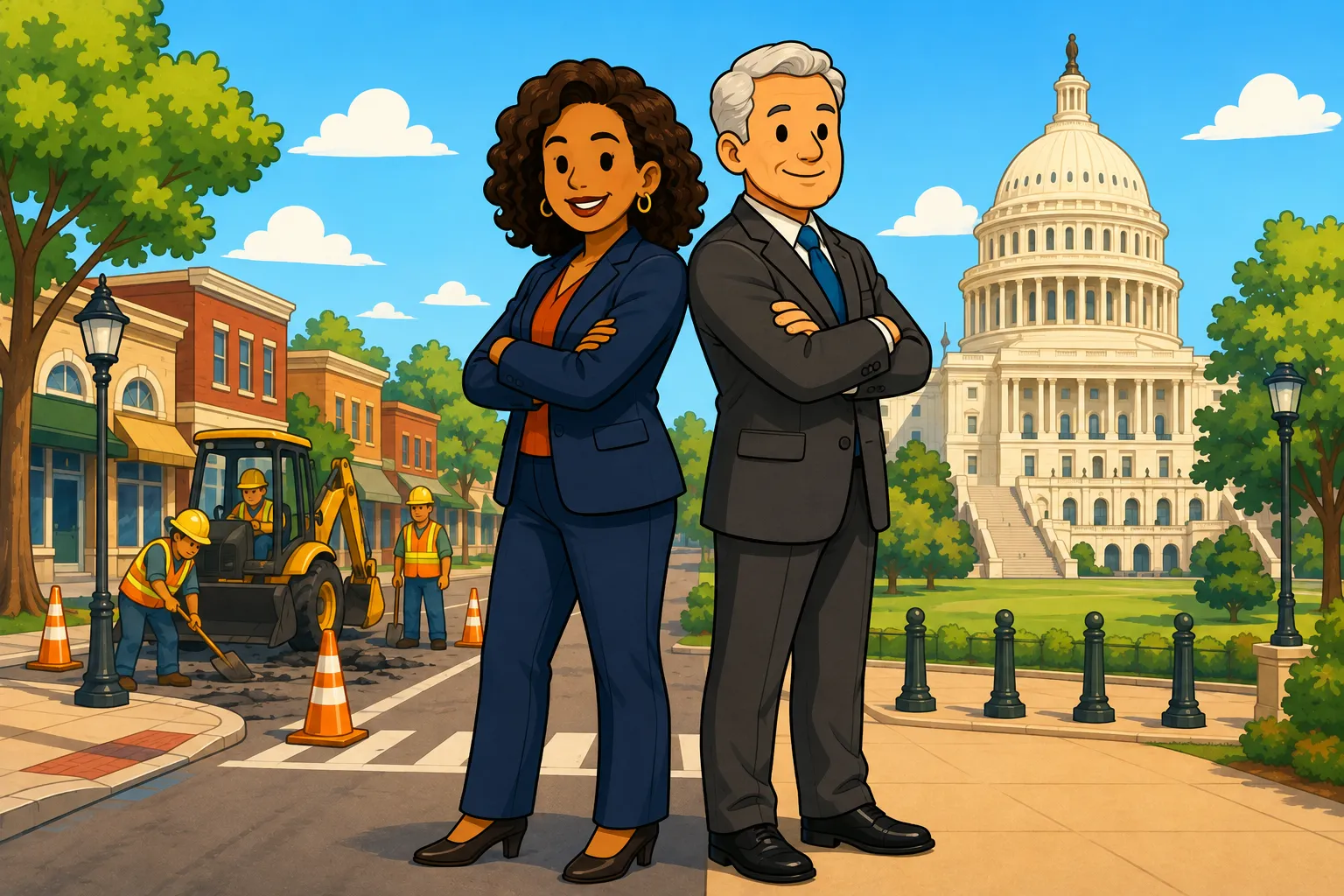
Levels of government determine who makes the decisions affecting everyday life. This activity helps students figure out who decides what.
Ask a middle schooler who’s in charge of the big decisions in American life, and you’ll usually get one answer: the President. Ask most adults, and you’ll get the same. There’s a quiet assumption baked into how we talk about government, that the important stuff happens in Washington and everything else is just paperwork.
Here’s the thing. A lot of the decisions that shape your kid’s daily life aren’t made in Washington at all. They’re made a few miles down the road, by people whose names never trend online, in meetings almost nobody shows up to.
That gap between where we think decisions get made and where they actually get made is one of the best teaching moments in civics. And there’s a free activity that cracks it wide open.
The question that trips everyone up
Learning for Justice (formerly Teaching Tolerance, a project of the Southern Poverty Law Center) put together a one-page handout called “Who Decides?” It’s part of a lesson called Democracy Class, built with Rock the Vote.
The setup is simple. Students read a list of 15 real policy questions and mark each one with an “L” if it’s decided at the local or state level, or an “F” if it’s decided at the federal level. That’s it. No lecture, no textbook chapter first. Just the list.
A few of the questions:
Local/State
Federal
Do we have a recycling program?
Do we teach sex education in schools?
Do we require police to wear body cameras?
Do we switch to year-round schooling?
Do we set the minimum wage at $15 an hour?
Do we lower the age for learners’ permits to 13?
Try marking those yourself before you keep reading. Most people are certain about a few and dead wrong about others.
Why kids (and parents) get it wrong
We get it wrong because national news trains us to. The stories that reach the most people, the ones that fill the biggest headlines and the loudest feeds, tend to be federal. So our mental picture of “government” fills up with Congress, the Supreme Court, and the White House.
Meanwhile, the decisions that touch a kid every single day get made somewhere else entirely:
- Your school schedule, dress code, and whether the district goes year-round? That’s your local school board.
- What’s taught in health class? Usually a mix of state law and local board policy.
- Whether police wear body cameras, whether there’s a curfew for teenagers, whether the town starts a recycling program or expands the bus route? City council, county commissioners, your mayor.
Even something that feels obviously “national,” like the minimum wage, is more layered than it looks. There’s a federal minimum, but states and even cities set their own higher rates. So the honest answer for a lot of the handout questions is “both, depending on where you live,” which is exactly the kind of messy, real answer that makes for a good discussion.
The moment it clicks
The payoff isn’t the answer key. It’s the look on a student’s face when they realize the person who decides whether their school starts at 7:30 or 8:15 is someone their family could email, or vote for, or go see in person on a Tuesday night.
Federal government can feel like weather. It happens to you. You watch it on the news and hope for the best. Local government is different. It’s a room with folding chairs and an agenda, and the people in it were chosen by a few thousand voters, sometimes a few hundred.
That’s where the voting lesson lands without you having to force it. Turnout in presidential elections runs high. Turnout in local elections, the school board seat, the city council race, the county bond measure, is often brutally low. A local race can come down to a handful of votes. Which means the decisions closest to your kid’s life are decided by the smallest number of people paying attention.
When a student sees that their vote carries more weight in the election that controls their own school, the whole “why should I bother” question answers itself.
How to run the activity at home or in class
You don’t need much. The handout is one page and free to download. Here’s a simple way through it.
1. Guess first, no help. Hand out the list and have each student mark L or F on their own. No phones, no discussion. The guessing is the point, because being wrong is what makes the real answer stick.
2. Compare and argue. Put them in pairs or small groups to compare marks. Where they disagree, make them explain their reasoning out loud. “I said federal because I heard about it on the news” is a great thing for a kid to hear themselves say, because it exposes exactly how we form these assumptions.
3. Reveal and dig in. Go through the answers together. For the ones that are “both,” don’t smooth it over, lean in. Explain how a federal floor and a state or local rule can stack on top of each other. This is where real civic understanding lives.
4. Make it local. Pull up your own town or state. What’s your city council working on right now? When’s the next school board meeting? Who’s your mayor? For older students, have them find one real local decision in the news and trace who actually made it.
5. Connect it to voting. Look up turnout numbers for the last presidential race versus the last local election in your area. The gap is usually shocking, and it makes the case for local voting better than any speech.
Where this fits in a full civics course
This activity is a great single lesson, and it’s even better as a doorway. Once a student understands that power is spread across local, state, and federal levels, a lot of other topics open up: federalism, separation of powers, why we have so many elected offices, how a bill in your statehouse can matter more to your life than one in Congress.
That layered structure is the backbone of American government, and it’s exactly what our Civics Club curriculum walks middle and high schoolers through, step by step, without pushing any political side. The goal isn’t to tell kids what to think about the issues on that handout. Marijuana laws, teachers carrying guns, curfews, sex ed, these are questions reasonable people land on differently. The goal is to make sure kids understand who gets to decide, and how they can be part of that decision when they’re old enough.
Because a citizen who knows where the power actually sits is a lot harder to sideline.
Try it this week
Download the “Who Decides?” handout and run it with your students or your own kids at the kitchen table. It takes twenty minutes and it’ll spark a conversation that runs a lot longer.
And if you want a full, non-partisan civics curriculum that builds on moments like this one, take a look at the Civics Club. We built it for exactly this: teachers and homeschool parents who want kids to grow up knowing how their government works and how to have a hand in it.
Take the Next Step with The Civics Club
“Who decides?” is one question. The Civics Club gives students the framework to answer it – and understand how the pieces of American government fit together.
Explore our ready-to-teach, non-partisan civics curriculum for classrooms, co-ops, and homeschool families.