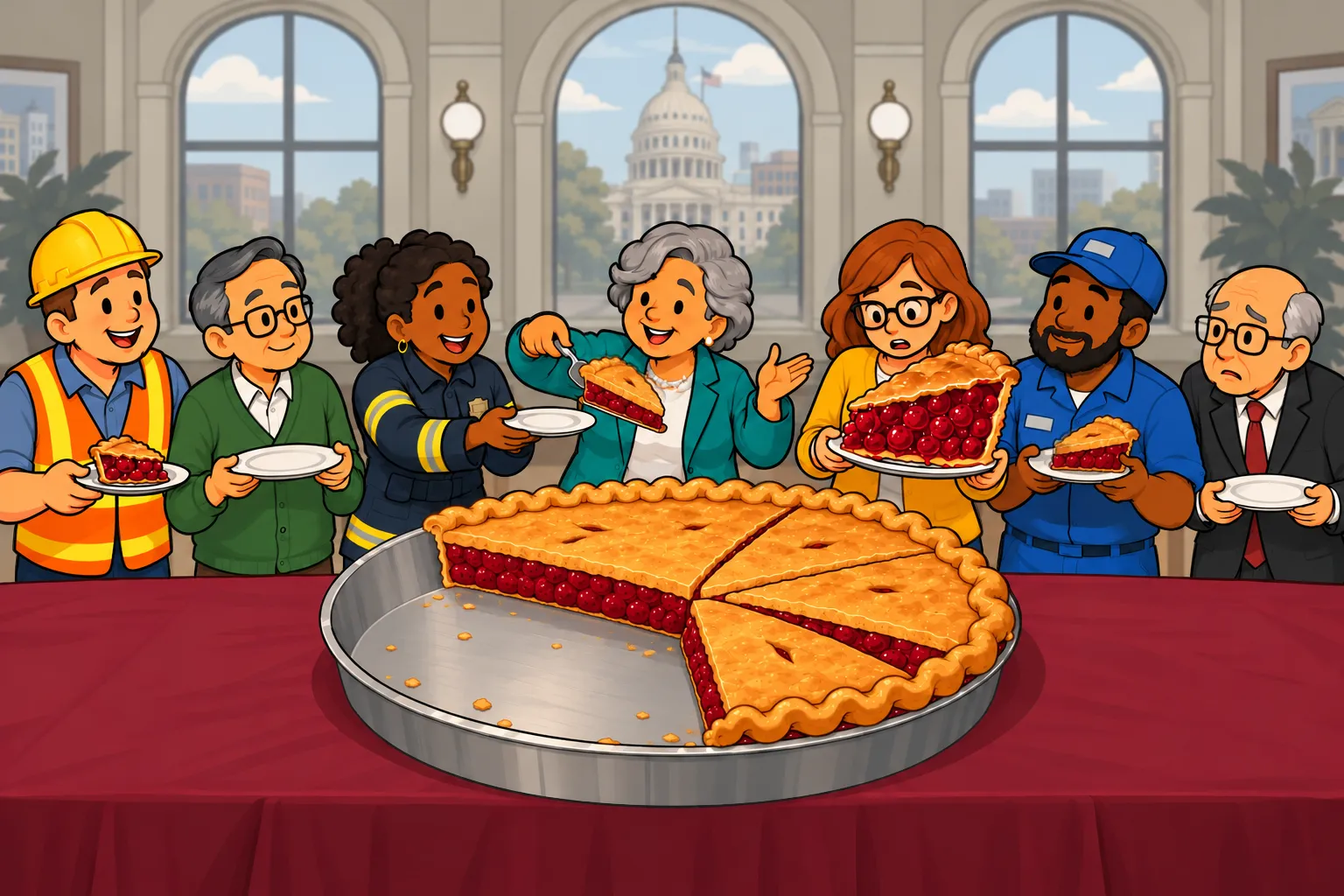
Tax dollars fund competing priorities at every level of government. This hands-on mock city budget activity teaches students how spending decisions, trade-offs, and the power of the purse work.
Ask a teenager where tax money goes, and you’ll usually get one of two answers. Either “I don’t know,” or a confident guess that most of it disappears into something wasteful. Foreign aid. Politicians’ salaries. Somebody’s fancy office.
Then hand that same teenager a pretend city, a fixed pile of money, and a list of things residents want. Within about ten minutes, they’re arguing about whether the library or the fire department needs a new roof more. And they’ve figured out the thing most adults never quite put into words: a budget isn’t a math problem. It’s a list of choices about what matters most.
That’s the heart of this lesson. Here’s what students should know about where tax dollars really go, and a mock city budget activity that makes it stick.
The big federal picture (it’s not what kids expect)
Start with the national numbers, because they bust a few myths right away.
In fiscal year 2025, the federal government took in about $5.2 trillion, according to the U.S. Treasury. About half of that, roughly $2.7 trillion, came from individual income taxes. Another $1.75 trillion came from payroll taxes and other social insurance contributions, mostly the money taken out of paychecks for Social Security and Medicare.
On the spending side, the government paid out about $7 trillion. Look at where the biggest pieces went:
- Social Security: about $1.58 trillion
- Medicare: about $997 billion
- Interest on the national debt: about $970 billion
- National defense: about $917 billion
Add those four up and you get nearly two out of every three federal dollars. Students are usually surprised that the government spent more on interest, basically the cost of past borrowing, than on the entire military. And because spending ran higher than revenue, the government ended the year about $1.8 trillion short. That gap is the deficit, and the government finances it through borrowing, which can increase future interest costs.
That’s a great moment to pause and ask: if you wanted to shrink that gap, where would you start? Every answer has a cost. That’s the whole lesson in one question.
FY2025 Federal Spending
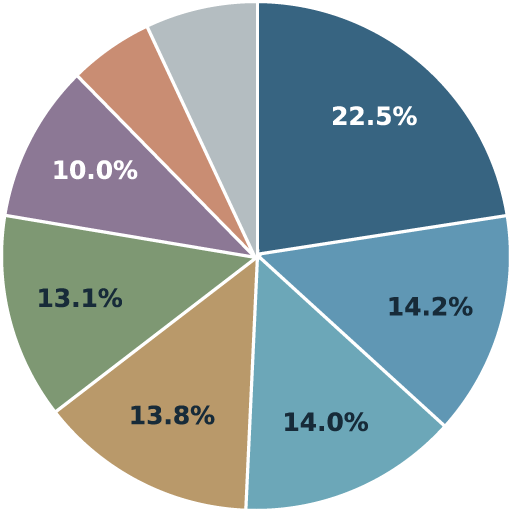
| Category | Spending | Share |
|---|---|---|
| Social Security | $1,580.686B | 22.5% |
| Medicare | $996.719B | 14.2% |
| Health | $978.878B | 14.0% |
| Net Interest | $970.359B | 13.8% |
| National Defense | $916.649B | 13.1% |
| Income Security | $701.584B | 10.0% |
| Veterans Benefits and Services | $377.162B | 5.4% |
| All Other Functions (net) | $487.955B | 7.0% |
Source: U.S. Treasury, FY2025 Combined Statement — Outlays by Function
Closer to home, the money looks different
Federal spending supports national programs and obligations, including Social Security, Medicare, defense, and interest on the national debt. Local government is a whole different animal. It’s the money that paves your street, staffs the fire station, and keeps the school lights on.
The biggest single piece of local spending is public schools. According to the Urban Institute, elementary and secondary education made up 39 percent of local governments’ direct spending in 2021. And the money for those schools comes from a mix of places: states covered about 46 percent of K–12 funding, local governments about 44 percent, and the federal government about 11 percent.
Where do local governments get their own money? Mostly from property taxes. The Tax Policy Center reports that property taxes brought in $609 billion for local governments in 2021, about 30 percent of their general revenue. The Urban Institute calls property taxes “the financial backbone of local governments”, and notes they make up nearly three-quarters of local tax collections.
So when a family pays property taxes on their home, or pays rent to a landlord who does, a big chunk of that money is flowing straight into the school down the road.
The power of the purse, in one sentence
Here’s the constitutional piece, and it’s short enough to memorize. Article I, Section 9 of the Constitution says: “No Money shall be drawn from the Treasury, but in Consequence of Appropriations made by Law.”
In plain English, federal money can only be spent when authorized through appropriations made by law. Congress holds what’s called the power of the purse: it decides how federal money is allocated, while the executive branch carries out spending within the limits Congress sets. The President can propose a budget, but Congress controls the funding.
That’s one of the most important checks in the whole system, and it works in a similar way closer to home. City councils, county commissions, and school boards vote on their budgets, usually in public meetings.
One difference is worth pointing out to students: unlike the federal government, nearly every state has to balance its budget. The National Conference of State Legislatures reports that every state except Vermont has a balanced budget requirement (and Vermont usually balances its budget anyway).
But the rules vary by state, and many states can borrow money for long-term projects such as roads and schools. What they generally can’t do is rely on borrowing to cover routine operating expenses year after year. That means new spending often requires cutting something else, raising more revenue, or finding savings elsewhere.
That’s exactly the pressure your students are about to feel.
The mock city budget activity
You don’t need anything fancy. A whiteboard, some paper, and maybe a spreadsheet for older students. This works at a kitchen table with one kid or in a classroom of thirty, and it takes about an hour. The town and its numbers are made up, which is the point. Students get the experience without needing to look anything up first.
- Found a town
Give students a fictional town with $10 million in annual revenue and a balanced budget. Last year’s spending was divided among six categories, and every department says it needs more this year.
Here’s the town’s starting budget:
| Department | Annual Budget |
|---|---|
| Schools | $2,500,000 |
| Police and Fire | $2,500,000 |
| Roads | $1,500,000 |
| Parks and Libraries | $1,000,000 |
| Trash and Water | $2,000,000 |
| Emergency Fund | $500,000 |
| Total | $10,000,000 |
Students will use these numbers as their starting point. They can change the allocations, but they’ll have to explain their decisions.
- Hand out the wish list
Residents have requests, and they all think theirs should come first. The school board wants more teachers. The fire chief says an old truck is failing. Parents want a playground, seniors want longer library hours, and Main Street has a pothole problem that’s getting worse.
Here’s what they’re asking for:
| Request | Additional Cost |
|---|---|
| Hire new teachers | $800,000 |
| Replace aging fire truck | $700,000 |
| Build a playground | $400,000 |
| Open library on weekends | $200,000 |
| Repair Main Street potholes | $300,000 |
| Total | $2,400,000 |
There’s a problem: the town has already allocated its entire $10 million budget. Approving everything would push spending to $12.4 million.
Ask students which requests they would approve, which they’d reject, and where they’d find the money.
- Set the one rule
The budget has to balance. Students can cut existing spending, raise property taxes, or add a fee, but every dollar in has to match every dollar out.
Have students write their revised budgets on paper or in a spreadsheet. They should account for any new spending, identify where the money comes from, and check their totals.
If they raise taxes, they have to explain to an angry homeowner why it was worth it. If they cut a department’s funding, they have to explain which services might be affected.
- Throw in a surprise
Halfway through, announce a storm that damaged the water plant. Repairs cost $500,000, and they can’t wait.
Students now have to revise their budgets again. Those who protected the town’s $500,000 emergency fund have a way to cover the repair. Those who spent it must find the money somewhere else.
Watch the room. Suddenly that emergency fund someone wanted to raid looks pretty smart. Ask students whether they should rebuild the emergency fund next year, and what they might sacrifice to do it.
- Hold a council meeting
Have students, or small groups, present their final budgets as if they’re on the city council. Others play residents during public comment.
Each group should explain which requests it funded, what it cut or changed, and how it handled the unexpected repair. Then vote on a final budget.
The goal isn’t to find the “right” answer, because there isn’t one. A student who protects the schools and a student who protects the fire department are both making a reasonable choice. What matters is that they can explain their trade-offs and listen to someone who chose differently. That’s exactly how real councils work, at least on their good days.
For older students, take it one step further. Pull up your own city or county budget. Many local governments post theirs online. Have students find the three biggest spending categories and compare them to their mock town. They’re often surprised by how familiar the arguments look.
Why this lesson sticks
Kids hear about taxes as something that happens to adults: a deduction on a paycheck, a bill in the mail, a complaint at the dinner table. This activity flips that around. For an hour, they’re the ones deciding, and they quickly learn that every “yes” to one group is a “not this year” to another.
That’s not a partisan lesson. People across the political spectrum disagree about how big government should be and what it should fund. But anyone who’s sat in the budget chair, even a pretend one, comes away understanding why those arguments are so hard, and why the people who control the money hold so much power.
How The Civics Club teaches the power of the purse
That’s exactly the kind of lesson we build into The Civics Club. Our curriculum gives middle and high schoolers a clear, non-partisan look at how government really works, from the Constitution’s checks and balances to the decisions made at their own city hall.
Students don’t just memorize that Congress controls spending. They practice weighing trade-offs, reading real sources, and defending a choice to people who see it differently.
Every lesson comes with discussion prompts and activities ready to use, whether you’re teaching a full classroom, running a co-op, or working with one student at the kitchen table.
A citizen who doesn’t know where the money goes can only complain about it.
A citizen who understands the budget can actually help shape it.
Ready to raise students who can follow the money? Explore The Civics Club curriculum today.
Turn Budget Decisions into a Civics Lesson
Help students understand where tax dollars go, why governments face difficult spending choices, and how budgets reflect community priorities.
The Civics Club provides ready-to-teach, non-partisan civics curriculum for classrooms, co-ops, and homeschool families.