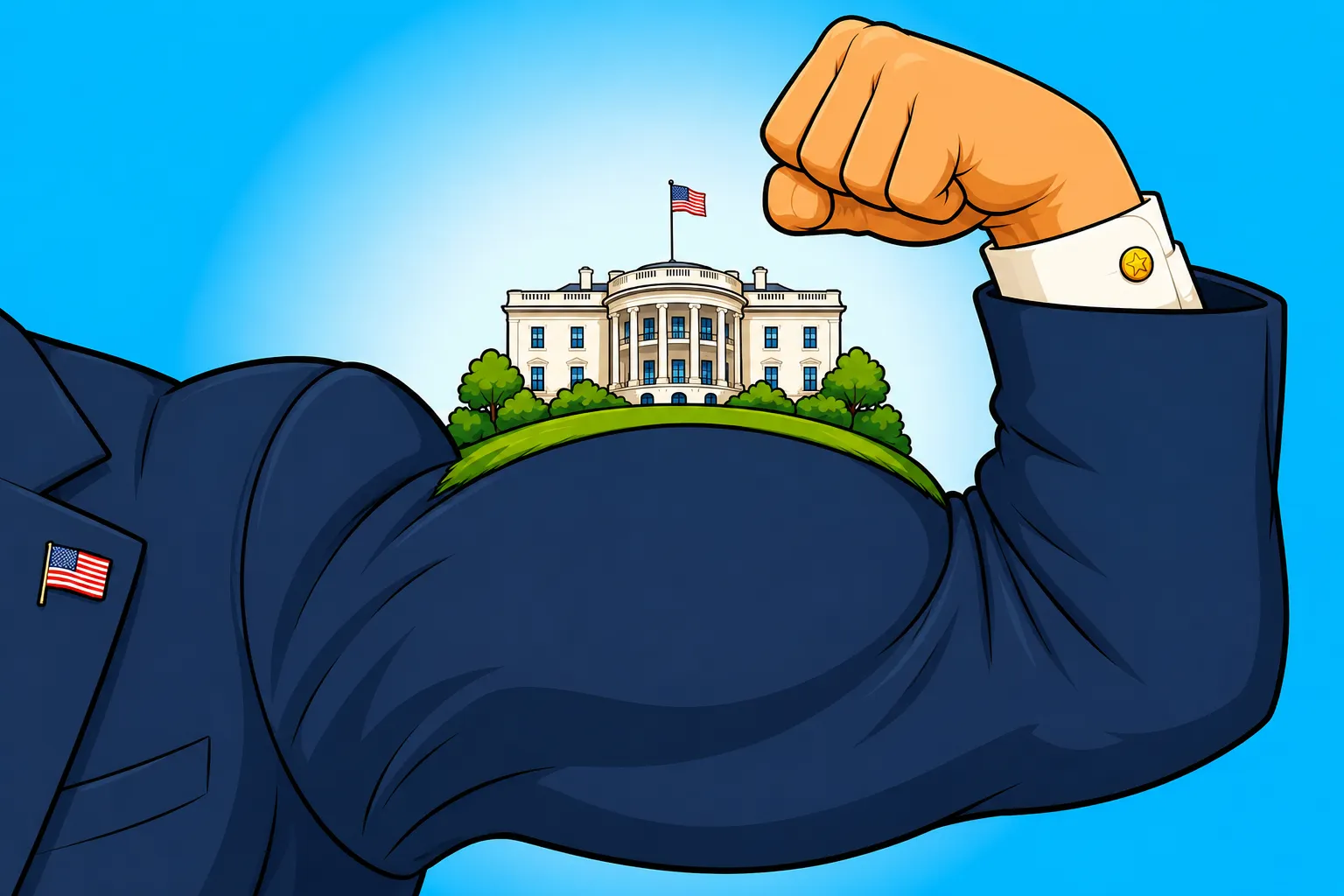
Presidential power is broad, but it has limits. This guide helps students understand what a President can actually do, where that authority ends, and how the other branches push back.
Ask a classroom full of middle schoolers what the President can do, and you’ll often hear the same answer: pretty much anything. The President is on the news every night. The President signs big papers at a fancy desk. The President is the most powerful person in the country, right?
It’s one of the most useful misunderstandings a civics teacher can work with. Because the honest answer — the president can do a lot, but far less than most people think — opens the door to the whole idea of checks and balances. And once students see how the pieces fit together, government stops being a list of names to memorize and starts making sense.
Here’s a lesson that works for middle and high schoolers alike, built around one clear question: What can a President actually do?
Start with the official list
You don’t have to invent the answer. The Harry S. Truman Library and Museum keeps a wonderfully plain-language chart for exactly this purpose. It’s called “Keeping the Balance: What a President Can Do and Cannot Do,” and it’s a perfect starting point for a class discussion.
| A President CAN: |
|---|
| Make treaties — but only with the approval of the Senate |
| Veto bills and sign bills |
| Represent our nation in talks with foreign countries |
| Enforce the laws that Congress passes |
| Act as commander-in-chief during a war |
| Call out troops to protect our nation against an attack |
| Suggest ideas that should become new laws |
| Lead his or her political party |
| Entertain foreign guests |
| Recognize foreign countries |
| Grant pardons |
| Nominate Cabinet members, Supreme Court justices, and other high officials |
| Appoint ambassadors |
| Talk directly to the people about problems |
| Represent the best interest of all the people |
| A President CAN NOT: |
|---|
| Make laws |
| Declare war |
| Decide how federal money will be spent |
| Interpret laws |
| Choose Cabinet members or Supreme Court Justices without Senate approval |
Print this out. Hand it around. Ask students what surprises them. Most will be shocked by the “cannot” list — especially that the President can’t declare war or decide how the country’s money gets spent. Those two feel like exactly the kind of thing a “most powerful person” should be able to do.
That surprise is the whole lesson. It’s where the real conversation begins.
The “cannot” list is where it gets interesting
Here’s the catch, and it’s a great one to spring on older students: the “cannot” list is technically true, but real life is messier than a chart. Presidents have found ways to stretch, bend, and work around several of those limits. This is the United States government, after all — the rules are clear, but the people operating inside them are creative.
Two examples make this come alive.
1. The purse strings: impoundment
The Constitution gives Congress the “power of the purse.” Congress decides how federal money is spent, and the President is supposed to carry those decisions out. So the chart is right: a President cannot decide how federal money will be spent.
But what if a President simply… doesn’t spend it?
That move has a name: impoundment. It’s when a President refuses to spend money that Congress has already approved, or delays spending it long enough to change what actually happens. On paper the President isn’t rewriting the budget. In practice, refusing to spend the money can control the outcome just as powerfully as writing the budget would.
The most famous showdown came in the early 1970s. Congress passed a major clean-water law and set aside billions of dollars to help cities build sewage treatment plants. President Richard Nixon disagreed with the spending and refused to release a large share of the money. Cities that were counting on those funds sued, and in the 1975 case Train v. City of New York, the Supreme Court ruled that the President had to release the funds Congress had appropriated.
Congress was frustrated enough that it passed the Congressional Budget and Impoundment Control Act of 1974, a law designed to limit exactly this kind of end run around the budget. Ask your students: if the Constitution already said Congress controls spending, why did Congress need to pass another law to protect that power? (Answer: because a clear rule and a followed rule aren’t always the same thing — and that’s what checks and balances are for.)
2. War powers: military action without a declaration
Now look at the second surprising line: a President cannot declare war. That power belongs to Congress. Article I, Section 8 of the Constitution says plainly that “Congress shall have the power… to declare war.”
And yet.
According to History.com, Presidents have ordered military action without a formal declaration of war again and again. Back in 1846, President James Polk sent the army into disputed territory near Texas, and Congress later censured him, saying the conflict had been “unnecessarily and unconstitutionally begun by the President.” During the Civil War, even Abraham Lincoln — who had defended Congress’s war powers as a young congressman — ordered a blockade of the South while Congress was out of session, admitting his actions might not be “strictly legal.”
The pattern only grew. President Harry Truman sent U.S. troops to Korea without asking Congress, calling it a “police action” rather than a war. The fighting in Vietnam raged for years without a declaration. Congress got so worried about Presidents going it alone that in 1973 it passed the War Powers Resolution to rein them in — though it hasn’t worked as cleanly as its authors hoped.
Here’s the statistic that stops students cold: the last time the United States formally declared war was in 1942, during World War II. In its entire history, the country has formally declared war only 11 times. And since 1942, every single U.S. President has used military force without a formal declaration of war.
That’s more than 80 years of military action without the one thing the Constitution seems to require. It’s a perfect discussion starter, and it’s not a partisan one — Presidents of every party have done it.
The point isn’t “the rules don’t matter”
It would be easy for students to walk away thinking the limits are fake. That’s the wrong lesson, and it’s worth heading off directly.
The rules matter enormously. Nixon’s impoundment ended at the Supreme Court, and Congress wrote a new law because of it. Polk got censured. Congress passed the War Powers Resolution. Every time a President has pushed against a limit, another branch has pushed back — sometimes weakly, sometimes with real force. That push and pull is the system working. The Founders didn’t design a machine where power sits still. They designed one where each branch is always testing the others, and the balance shifts a little depending on who’s paying attention.
That’s a far more honest — and far more interesting — story than “the President can do anything” or “the President is boxed in by rules.” The truth lives in the tension between the two.
How to teach it
A few ways to bring this into your classroom or homeschool:
- Sort the chart. Give students the Truman Library’s “can” and “cannot” lists cut into strips and have them sort the cards before you reveal the answers. The debates over where each card goes are the best part.
- Play both branches. Split the room. One side plays a President who wants something done; the other plays a Congress that controls the money and the war power. Give them a scenario and let them negotiate.
- Find a current example. Have older students watch the news for one week and flag any moment where a President and Congress disagree over spending or military action. There’s almost always one.
- Ask the big question. End with: Is it a good thing that Presidents can stretch their power, or a dangerous one? There’s no clean answer — which is exactly why it’s worth discussing.
Where the Civics Club curriculum fits
Understanding Presidential power isn’t about memorizing a list. It’s about seeing how the whole system holds together — how one branch checks another, where the written rules end and real-world practice begins, and why an informed citizen needs to know the difference.
Our Civics Club curriculum is built for exactly this. It gives middle and high school students the framework to understand the three branches, checks and balances, and the real tensions that make American government work — with lessons, discussion guides, and activities you can use whether you’re running a classroom of thirty or a kitchen-table homeschool of one.
If “what can a President do?” sparked a good conversation, that’s the whole idea. Explore the Civics Club curriculum and give your students the tools to answer the harder questions for themselves.
Take the Next Step with The Civics Club
Give students a clearer way to understand how American government actually works.
The Civics Club provides ready-to-teach, non-partisan civics curriculum for classrooms, co-ops, and homeschool families.