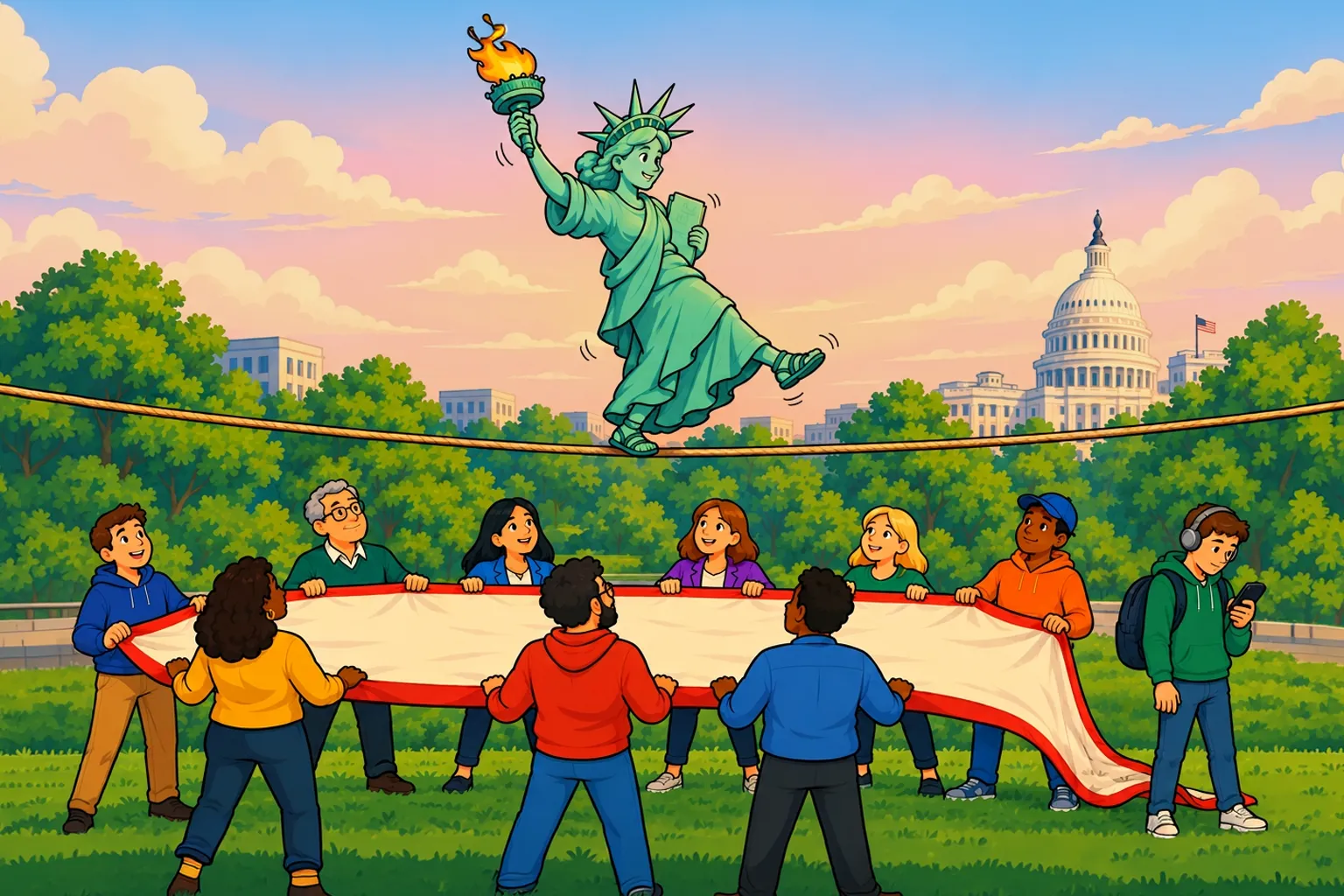
Constitutional rights are yours whether or not you take part in civic life, but protecting those rights requires citizens who do.
Imagine sitting around the dinner table when a headline pops up about a controversial new state law. Someone expresses outrage over how the decision infringes on fundamental liberties. But then comes the follow-up question: Did the people affected actually turn out to vote in the local and state elections where those decisions were made?
This scenario gets straight to the heart of a philosophical question central to American democracy: Can rights genuinely exist without responsibilities?
In a self-governing republic, citizens are granted extraordinary protections under the law. Yet, those protections do not maintain themselves in a vacuum. When a society demands total personal freedom while abandoning the civic obligations that preserve it, can that freedom survive? And if we fail to uphold our duties as citizens, do we retain a legitimate claim to be angry when our rights are compromised?
These are not just dry, theoretical puzzles for constitutional lawyers. They represent the exact kind of high-level, thought-provoking questions that ignite meaningful civics discussions with middle and high school students.
The Legal Framework: Rights vs. Responsibilities
To examine whether rights and responsibilities can be separated, it helps to start with how citizenship is defined. According to Cornell Law School’s Legal Information Institute, a citizen is a person who, by place of birth, nationality of one or both parents, or naturalization, is granted full rights and responsibilities as a member of a nation or political community.
Notice that the definition does not offer a choice between the two. Citizenship is inherently a dual concept.
The Constitutional Rights We Enjoy:
Rights are the fundamental protections guaranteed to individuals, primarily restricting government overreach:
- Freedom of Speech, Religion, Press, and Assembly: The liberty to express ideas, worship freely, and gather peacefully without government censorship.
- Due Process and Fair Legal Standards: Protection against arbitrary treatment, including a fair trial by an impartial jury.
- The Right to Vote: The authority to choose the representatives who create laws and govern the community.
The Civic Responsibilities We Owe:
Responsibilities represent the commitments required to keep a democratic system operational and healthy:
- Participating in the Democratic Process: Voting in elections, staying informed on civic issues, and engaging in constructive public dialogue.
- Serving on a Jury: Fulfilling jury duty when summoned to ensure fellow citizens receive a fair trial.
- Obeying Laws and Paying Taxes: Respecting the legal framework and contributing financially to public services and defense.
When students review these lists side by side, the core dilemma emerges: Are rights and responsibilities inextricably linked, or can one exist completely independent of the other?
Deep Civic Scenarios for Kitchen-Table Discussion
To move past superficial definitions, present your student with scenarios that directly pit individual rights against civic inaction.
Scenario 1:
The Disengaged Voter and the Controversial Law
A state legislature passes a law restricting certain local activities. A citizen who never registers or votes in state or local elections is furious about the new restriction, calling it an unconstitutional infringement on their freedom.
- Ask your student: If a citizen chooses not to participate in choosing their representatives, do they still have a moral right to complain about the laws those representatives pass? Does skipping the democratic process waive your right to criticize the outcome?
- The Civic Insight: Voting is the primary mechanism through which citizens shape their government and protect their liberties. When voter turnout drops — especially in state and local elections where key daily policies are decided — a small minority end up deciding policies for everyone else.
Scenario 2:
The Empty Jury Box
A citizen receives a jury summons in the mail. Viewing it as an annoying chore, they toss it aside and ignore it. Two years later, that same individual is falsely accused of a minor crime and demands a swift, fair trial before a thoughtful jury of their peers.
- Ask your student: Can the constitutional right to a jury trial exist if citizens systematically refuse to perform jury duty? Is it fair to expect a jury of peers when you refuse to be a peer for anyone else?
- The Civic Insight: The Sixth Amendment guarantees a jury trial, but the Constitution does not provide a paid, professional jury corps. It relies entirely on everyday citizens fulfilling their civic obligation. One person’s constitutional right is dependent on another person’s willingness to perform their duty.
Both Sides of the Debate: Are Rights Conditional?
When discussing these scenarios with middle or high schoolers, guide them to examine both philosophical perspectives without rushing to a simple conclusion.
Perspective A:
“Rights and Responsibilities Are Inextricable”
This view holds that a free society is a reciprocal contract. Rights are maintained through collective effort, vigilance, and participation.
If citizens ignore their civic duties — by skipping elections, dodging jury service, or remaining willfully uninformed — the democratic infrastructure weakens. Power concentrates in fewer hands, rights gradually erode, and the government becomes unanswerable to the public. From this standpoint, claiming to care about rights while abandoning responsibilities is fundamentally contradictory. You cannot neglect the foundation of a building and then be surprised when the roof collapses.
Perspective B:
“Rights Are Inherent and Must Never Be Conditional”
The counterargument rests on a foundational principle of American constitutional law: fundamental human rights are inherent, not earned. They are not prizes awarded by the government to “good citizens” who complete a checklist of duties.
If constitutional protections became conditional on fulfilling responsibilities, who would decide the standard? Would the government decide that failing to vote strips away your First Amendment protection? Would ignoring jury duty disqualify you from due process? Making rights conditional transforms them from absolute limits on government power into temporary privileges granted at the state’s discretion.
How Civics Education Protects Our Freedoms
How do we prevent our liberties from eroding without resorting to making rights conditional?
Freedom relies fundamentally on an informed, engaged, and vigilant citizenry. Citizens cannot defend rights they do not understand, nor can they hold representatives accountable if they do not know how the system operates.
A rigorous civics education equips young people with essential tools:
1
Understanding Constitutional Mechanics: Learning how power is divided between local, state, and federal levels so students know where and how to advocate for change.
2
Recognizing the Weight of Civic Action: Understanding that casting a ballot or serving on a jury is not an empty routine, but a direct defense of human liberty.
3
Fostering Constructive Debate: Learning to evaluate competing viewpoints, analyze policy trade-offs, and engage in civil discourse on complex public issues.
Bringing Real Civics to Your Learning Space
At The Civics Club, we believe civics should never be reduced to memorizing definitions or filling out worksheets. Our middle and high school curriculum is designed to bring deep, essential civic questions directly to your learning space.
Through interactive lessons, primary source analyses, and structured discussion prompts, we help students explore how government works and why their participation matters. We give young people the tools to think critically about their rights, embrace their responsibilities, and become active, thoughtful leaders in their communities.
Ready to inspire your student with civics discussions that matter?
Help students understand that constitutional rights belong to everyone, while protecting those rights depends on informed and engaged citizens.
The Civics Club provides ready-to-teach, non-partisan civics curriculum for classrooms, co-ops, and homeschool families.