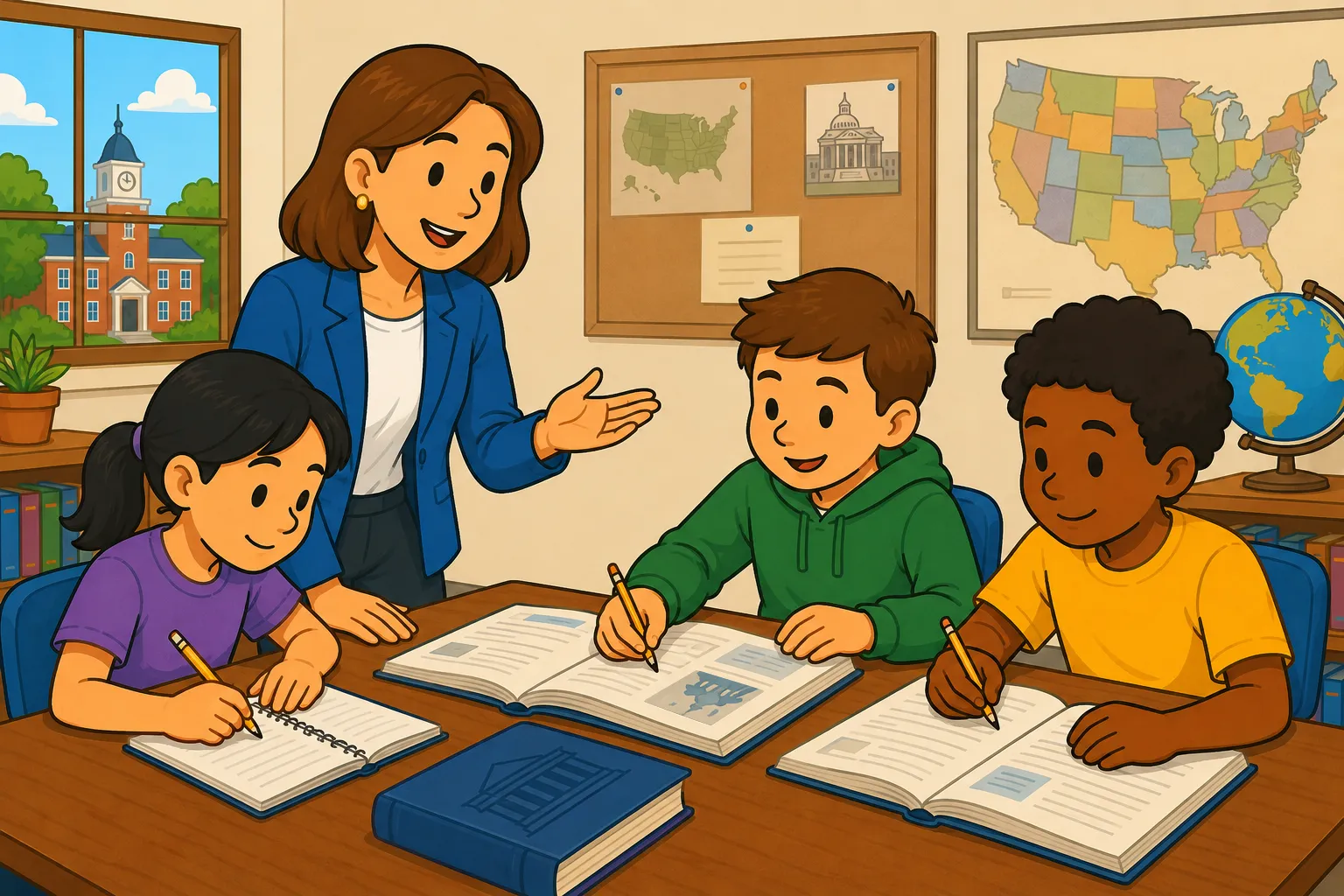
Teaching civil discourse gives students the skills to discuss difficult issues with respect, curiosity, and confidence.
We’ve all been there. You’re at dinner with friends, and someone brings up immigration, or guns, or just how terrible “the other side” is. The room changes. A couple of loud people talk like everyone at the table already agrees with them. Everyone else goes quiet, not because they have nothing to say, but because it’s safer to say nothing. There’s no real conversation. Just posturing, a few proclamations, and a lot of people staring at their plates. Nobody knows how to actually talk about it, or they’re too scared to try.
Now picture a thirteen-year-old in that room. They’re watching. And they’re learning that this is how it’s done: pick a team, repeat what your team says, and treat anyone on the other team as the enemy. Kids don’t even need the dinner table anymore. They’re getting the same lesson in the comments under an Instagram post, where two classmates who barely understand an issue are already calling each other names over it.
If you teach middle or high schoolers, you’ve seen a version of this. A student repeats a talking point they can’t explain. A discussion turns into a standoff. A kid shuts down because they’re scared of saying the “wrong” thing in front of classmates. This is what growing up in a polarized country does, and it’s exactly the thing a good civics education is supposed to fix.
What polarization actually means
Political polarization is the movement of opinions away from the center and toward the extremes. In plain terms, it’s what happens when the two sides drift apart and the middle empties out.
It hasn’t always looked like this. In the early 1990s, the Republican and Democratic parties agreed on more than they disagreed on, and there was real variety of opinion inside each party. Over the last 30 years, the two parties have pulled apart, and the space where they overlap has shrunk. The share of Americans who hold consistently “left” or consistently “right” views has grown, and the middle ground has thinned out.
Here are the numbers that show how fast this happened. In 1994, only 21% of Republicans and 17% of Democrats had a very unfavorable view of the other party. By 2022, those numbers had jumped to 62% of Republicans and 54% of Democrats. In one generation, deep dislike of the other side roughly tripled. (Those figures come from the Pew Research Center, tracked through Facing History & Ourselves’ explainer on polarization.) And the US isn’t just polarized. A 2020 Brown University study found that the US is polarizing faster than other established democracies.
There’s a specific kind of divide underneath those numbers that researchers call affective polarization, or emotional polarization. It’s not about disagreeing on tax rates. It’s about feeling that the people on the other side are close-minded, dishonest, or even a threat. Here’s how deep it runs: Pew found that 30% of consistent conservatives would be unhappy if a family member married a Democrat, and 23% of consistent liberals said the same about the prospect of a Republican in-law. When your politics start shaping who you want your kids to marry, the divide has stopped being about policy. That’s the version of polarization that shows up at your dinner table, and it’s the version that does the most damage.
Why this is a problem worth teaching about
Some disagreement is healthy. When the two parties stand for genuinely different things, voters get a real choice instead of two versions of the same thing. Political diversity is normal and good.
The problem starts when people stop seeing the other side as fellow citizens and start seeing them as enemies. A few things happen when we get there:
Nothing gets done. When lawmakers won’t work with the other party, government stalls. Bills that most people actually want can die because neither side wants to hand the other a win. Kids notice this. It’s part of why so many of them think politics is pointless.
People stop talking to each other. More than half of Americans, 53%, say that talking politics with someone they disagree with is generally stressful and frustrating. So they stop. Families avoid the topic at dinner. Neighbors assume the worst about the yard sign next door. A democracy where citizens can’t stand to talk to each other is a democracy running on empty.
It opens the door to worse things. When leaders and media paint the other side as evil, some people start to accept that anything goes to beat them. In one 2023 survey, 38% of Americans said they’d support “a leader who is willing to break some rules if that’s what it takes to set things right.” That’s a scary number in a country that runs on rules.
None of this means your kid has to pick a side and defend it harder. It means the opposite. The thing our country is short on isn’t passion. It’s people who can hold their own views and still work with someone who sees the world differently.
Where the divide comes from (so students can spot it)
You can’t teach kids to resist something they can’t name. Researchers point to a few forces behind the split, and every one of them is worth a lesson:
In-group bias. We’re wired to trust people in our group and distrust people outside it. Once someone identifies with a party, they often change their opinions to match the group rather than the other way around. Studying this helps kids catch themselves doing it.
Media bubbles. Most people see news that already agrees with them, and they have few friends on the other side of their feed. Platforms like YouTube use algorithms that can nudge viewers toward more and more extreme content without them noticing. Learning how a feed is built is a survival skill now.
Demonizing the other side. When a candidate or a channel treats opponents as evil instead of just wrong, the emotional divide grows. Kids who can name this move are far less likely to fall for it.
How elections work. This is the machinery behind a lot of the anger, and it’s more interesting than it sounds. Take gerrymandering: it’s the practice of drawing a voting district’s boundaries to give one party an advantage. Pack enough of one party’s voters into a district and the general election is over before it starts. The only race that matters is the primary, where each party picks its candidate. And primaries are won by pleasing the most fired-up members of the party, not the people in the middle. So the system quietly rewards candidates who play to the extremes and punishes the ones who’d rather compromise. Once students see how the districts and the primaries actually work, a lot of “why are politicians like this?” suddenly makes sense.
A student who understands these four forces reads the news differently. They stop asking “whose side is this?” and start asking “what is this trying to do to me?”
What we actually want: citizens, not partisans
Here’s the goal, and it has nothing to do with the left or the right. We want young people who can:
- Look at an issue from more than one angle before deciding what they think
- Tell the difference between a policy and a team jersey
- Read a source and figure out its slant
- Disagree with someone and still respect them
- Work with people who aren’t like them to get something done
That last one matters more than people realize. The research backs it up: Americans feel a lot less hostile toward the other side when they’re reminded of a shared identity, like being Americans, or even just fans of the same team. Working on a shared project shrinks the gap. Winning arguments doesn’t.
And for all the doom in the numbers, Americans still agree on more than the headlines suggest. Around 85% support background checks for private gun sales. About 78% support making it easier for highly skilled immigrants to come here. Roughly 60% back major spending to make homes more energy efficient. The common ground is real. Most people just never get shown it.
How The Civics Club teaches this
Our curriculum was built for exactly this moment. We teach civics to middle and high schoolers in a way that’s two things at once: relatable, and genuinely unbiased.
That second part is rare, and we protect it. We don’t tell students what to think about hot issues. We teach them how to think: how to break a policy down to what it actually does, how to argue the strongest version of a position they disagree with, how to spot loaded language and slanted sources, and how to have a hard conversation without it turning personal.
When we cover a divisive topic, we present the real reasons thoughtful people land on different sides. A student finishes a unit better able to explain both positions than most adults on cable news. That’s not fence-sitting. It’s the foundation of good judgment. You can’t decide what you believe until you understand what you’re deciding between.
We also give students practice being participants, not spectators. They analyze real issues, weigh trade-offs, and see where people across the spectrum already agree. The point is to grow citizens who can think for themselves and still build something with the people next to them.
That’s the whole game. A country full of people who can only shout past each other is stuck. A country full of people who can reason clearly and work together can fix almost anything. We’re trying to raise the second kind, one classroom and one kitchen table at a time.
If you want to see how it works, take a look at our curriculum. Whether you’re running a full classroom or teaching one kid at your dining room table, it’s built to hand your students the one skill this country needs most: the ability to think clearly, judge fairly, and still reach across the aisle.
Ready to Teach Civics Without the Political Headaches?
The Civics Club gives homeschool families, teachers, and co-ops a complete, non-partisan civics curriculum for grades 6–12. Students learn how government works through engaging lessons, discussions, and classroom activities designed to build civic knowledge, not tell them what to think.
Explore the curriculum to see what’s included, or try a free sample lesson and see how it works in your own home or classroom.