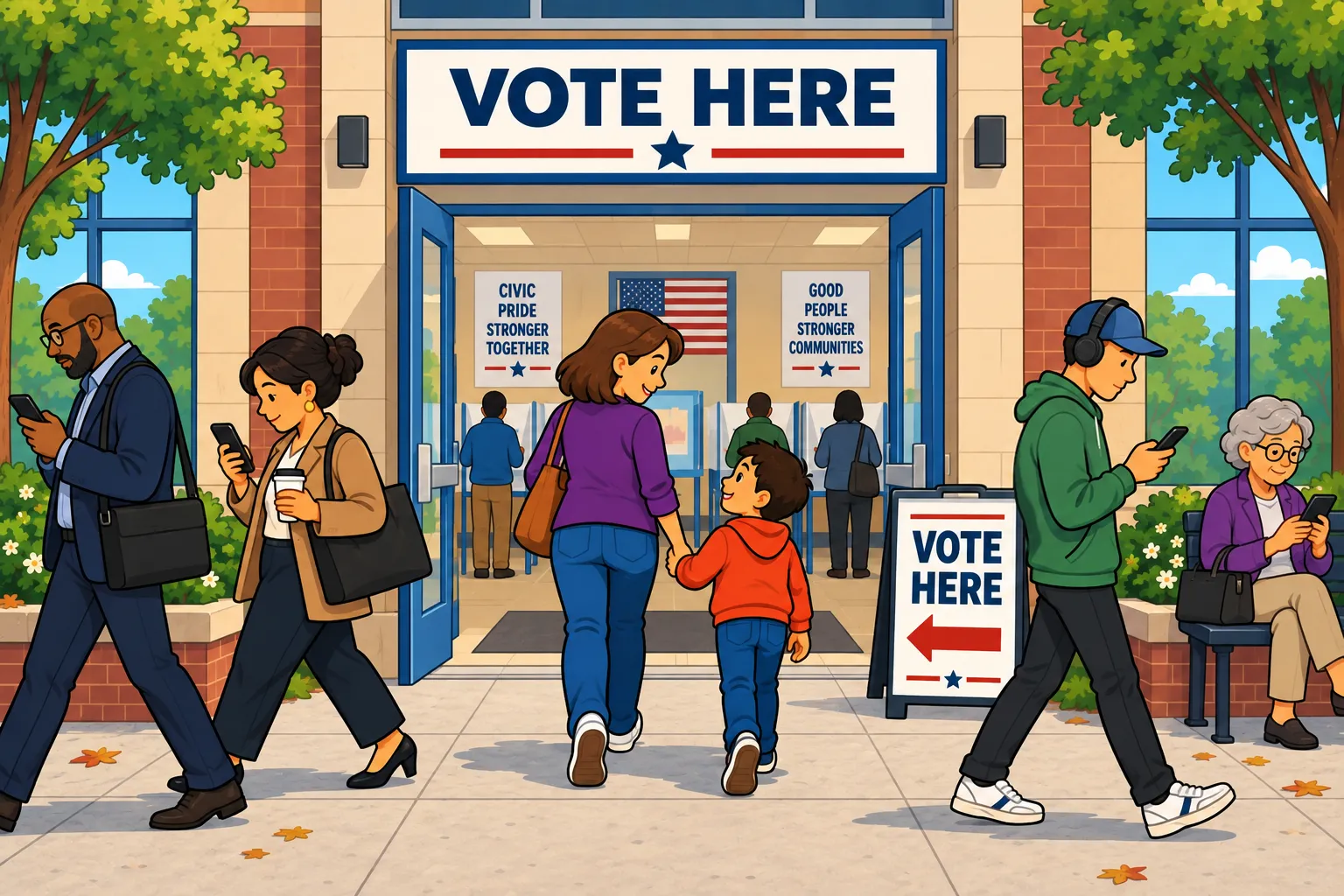
Voting is imperfect. It still matters. Here’s how to teach both.
Ask a room of teenagers whether their vote will matter someday, and you’ll get a shrug. Maybe a flat “not really.” They didn’t invent that attitude. They picked it up from adults who say the same thing, from headlines about gridlock, and from the sense that the whole thing is rigged, slow, and pointless anyway.
Here’s the hard part for those of us teaching civics: they’re not entirely wrong about the obstacles. Voting really can be a hassle. One vote really is a tiny slice of millions. If we pretend those things aren’t true, students tune us out. So the honest approach is to name the reasons people skip voting, take each one seriously, and then show why the vote is still worth casting. That’s a lesson kids will actually respect.
Start by putting the real reasons on the table. When students see that we understand the objections, they trust the rest of what we say.
Why so many citizens don’t vote

Voter apathy. Plenty of people believe their single vote won’t change a thing, so they stay home. Why bother standing in line to add one drop to an ocean? When enough people think this way, it becomes a self-fulfilling prophecy. Turnout drops, and a smaller and smaller group ends up deciding things for everyone.
Low turnout and lost trust. Low turnout just means a small share of eligible voters actually cast a ballot, in person or by mail. The rest chose not to. Sometimes that’s apathy. Often it’s something deeper: people don’t trust that the process is fair, or that their vote will be counted honestly, or that the person they elect will keep any promises. Once you stop believing the system works, sitting out feels reasonable.
Accessibility problems. For some citizens, the barrier isn’t attitude. It’s logistics. Limited polling hours that clash with a work shift. Lines that stretch for hours. Strict ID rules that trip people up. A single mom working two jobs may want to vote and still not be able to find the time or the paperwork to make it happen.
Registration hurdles. In a lot of places you can’t just show up on election day. You have to register first, sometimes weeks ahead, sometimes through a confusing form or a deadline nobody advertised. Miss the window and you’re locked out, even if you fully intended to vote.
These are legitimate. A student who says “voting is a pain and it doesn’t matter” is repeating something half-true. Our job is to handle the other half.
Why one vote actually does matter
The “my single vote is meaningless” idea falls apart the moment you look at real elections.
Close races happen more often than people think, and they happen most in the elections that touch daily life the hardest: school boards, city councils, mayors, county measures, state legislators. These races are sometimes decided by a few dozen votes. There are documented local elections settled by a single vote, and some literally decided by a coin flip after a tie. In a small election, one classroom’s worth of voters can flip the result.
Then there’s the part the “one vote” math misses. People almost never vote alone. They vote in households, friend groups, congregations, and neighborhoods. The teenager who registers and shows up often brings a parent, a sibling, a friend along for the ride. One engaged voter tends to create several. That’s how movements start, not with one heroic ballot, but with one person who won’t stay home and won’t shut up about it.
And low turnout cuts both ways. When most people skip an election, the few who show up hold outsized power. So “everyone else is staying home” isn’t a reason to stay home too. It’s the exact moment your vote counts the most. Teach students to see a low-turnout election as an opportunity, not an excuse.
How to plan around the accessibility hurdles
This is where a civics lesson turns into a life skill. Most voting obstacles shrink when you plan ahead, and planning ahead is something you can actually teach a fifteen-year-old to do. Walk students through a simple checklist they can use the first time they’re eligible, and share with the adults in their lives now.
Register early, and check it. Don’t wait for the deadline. Register as soon as you’re eligible, then check your registration status a few weeks before each election, because records can change or get purged. Most states have an official site where you can confirm it in under a minute.
Know the rules before election day. Look up what ID your state requires and put it with your keys the night before. Find your polling place ahead of time so you’re not scrambling. If you’ll be at work or school all day, that’s what early voting and mail-in ballots are for.
Vote early or by mail when you can. Many states let you vote days or weeks ahead, or mail a ballot from your kitchen table. That single choice erases the “long lines” and “polls closed before I got off work” problems entirely. If you mail it, mail it early so it arrives on time.
Make a plan, not just an intention. Research is clear that people who decide exactly when and how they’ll vote follow through far more often than people who just plan to “get around to it.” Pick the day. Pick the time. Know the route. A vague good intention loses to a specific plan every time.
Have students build this plan as an assignment, even the ones who can’t vote yet. When their eighteenth birthday comes, the process is already familiar instead of intimidating.
Why trust in the process matters, and what we can actually trust
The trickiest reason people skip voting is the belief that the whole thing is corrupt, so why participate. This is where teachers and parents have to be careful and honest. The answer isn’t blind faith that everything is perfect. It’s teaching students what safeguards actually exist so they can trust the process for good reasons, not just hope for the best.
Here’s what holds an election together, and it’s worth walking students through each one:

It’s decentralized on purpose. There is no single button someone could press to change a national result. Elections are run locally, county by county, using thousands of separate systems. That makes large-scale tampering enormously hard to pull off and easy to catch.
Paper backs up the machines. Most places keep a paper record of every vote, so results can be checked against a physical trail. If a machine count is ever questioned, there’s something real to recount.
Both sides watch. Poll workers and official observers from competing parties sit in the same room and watch the same process. They disagree about almost everything else, which is exactly why their agreement that the count was fair means something.
Audits and recounts are routine. Close races get recounted. Many states run audits after every election as a standard check, not because anything went wrong. The system is built to double-check itself.
Courts require evidence. When results are challenged, they go before judges who demand actual proof, not just accusations. That’s a real filter, and it’s public.
None of this means elections are flawless. Mistakes happen, and citizens should absolutely push to fix real problems. But there’s a big difference between “the system has flaws we should improve” and “the whole thing is fake, so I won’t take part.” The first is healthy civic engagement. The second hands your share of the decision to someone else. We want students to land on the first, and to understand the machinery well enough to defend that view.
Where a civics course fits in
You can cover all of this at your kitchen table or in a co-op, and you should. But it lands harder when it’s part of a real course, with discussion, primary sources, and the chance to walk through a mock registration and a mock ballot before it counts for real.
That’s what our Civics Club curriculum is built for. It’s a full civics program for middle and high schoolers, secular and non-partisan, designed for homeschool families, co-ops, and classrooms. Students don’t just memorize how a bill becomes a law. They practice the actual skills of citizenship, including how to register, how to research a ballot, and how to talk through a hard issue without turning it into a fight.
A generation that understands both the obstacles and the safeguards is a generation that shows up. Give your students the full picture, and they’ll be the ones in line, plan in hand, on their first election day.
Take the Next Step with The Civics Club
Help students understand why civic participation matters and how American government actually works.
The Civics Club provides ready-to-teach, non-partisan civics curriculum for classrooms, co-ops, and homeschool families.