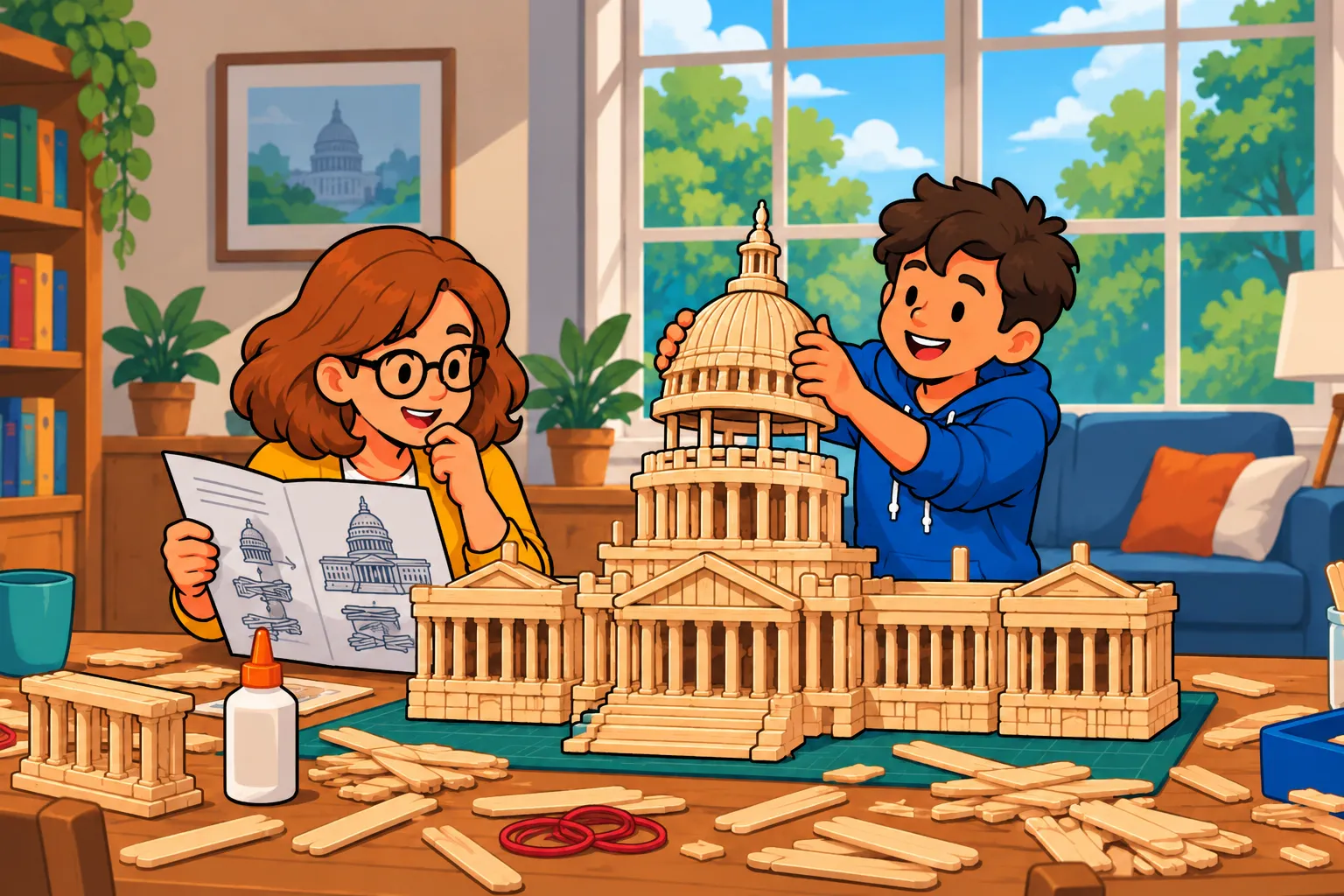
You don’t need to be a government expert to teach civics. Learn alongside your students with structured lessons, hands-on activities, and tools for evaluating political information.
Imagine your teenager asks a simple question over breakfast: “Can the president just make a new law?”
You start to answer. Then you remember something about executive orders. Congress has to pass laws, right? But presidents can veto them. And what happens if the Supreme Court gets involved?
Suddenly, a question that seemed straightforward has turned into a constitutional puzzle. Your teenager is still waiting for an answer, and you are considering whether it is too late to switch today’s lesson to math.
If you have ever felt this way, you are in good company. Plenty of adults follow elections, pay taxes, and vote regularly without feeling particularly confident about how government actually works.
For homeschool parents, that uncertainty can be especially intimidating. You are responsible for teaching a subject that involves complicated institutions, centuries of history, and political disagreements that even the experts cannot seem to settle.
But here is something worth remembering: You do not need to know everything about government to teach your children how to understand it.
In fact, learning alongside them might be one of the most valuable parts of the experience.
Start With How Government Works, Not Who’s Winning
One reason civics feels overwhelming is that we tend to confuse government with politics. Turn on the news, and you will hear about political parties, campaign promises, congressional investigations, and the latest controversy in Washington. It is a lot to follow, and much of it changes from one day to the next.
Fortunately, teaching civics does not require you to keep up with every political argument. Instead, start with the rules that govern the system.
Think about teaching someone baseball. You would not begin by explaining every controversy surrounding professional teams or debating which player deserves a bigger contract. You would explain the basic rules, how players score, and what each position does.
Government works much the same way. Before your student can understand whether a leader has exceeded their authority, they need to know what authority that office actually holds under the Constitution. Before they can evaluate a court decision, they need to know what courts do and why judicial independence matters. And before they can understand why Congress struggles to pass legislation, they should know how the legislative process is structured.
This is where The Civics Club takes much of the pressure off homeschool parents. Our first course begins with the foundations of American government, covering its structure, the three branches, and the system of checks and balances. Students examine primary sources, including the U.S. Constitution itself, rather than relying strictly on commentary. The lessons provide a clear, logical sequence so you do not have to design a course from scratch or become an expert before opening the first lesson. You can simply learn the rules together.
It’s OK to Say, “I Don’t Know”
Somewhere along the way, adults developed the idea that teachers must always have all the answers. But homeschooling is built on a different truth: parents learn alongside their kids every day.
Suppose your child asks whether the federal government can require every state to follow the same education policy. Rather than guessing, try saying: “That’s a good question. Let’s find out together.”
Now you have turned a moment of uncertainty into a practical lesson in civics. Together, you can examine the Tenth Amendment, look at the responsibilities of state education departments, and explore how federal funding influences local decisions.
More importantly, you demonstrate an essential habit of good citizenship: being informed does not mean already knowing everything. It means being willing to ask questions, examine original evidence, and look at the facts. Your job isn’t to eliminate every uncertainty, but to help your children become comfortable examining difficult questions without jumping to conclusions.
Let Your Kids Experience Government Instead of Just Reading About It
You can explain the election process with a textbook. Or you can let your students experience the decisions candidates and voters face firsthand.
Imagine holding a family election for an imaginary town. Your teenager runs for mayor, while another family member becomes the opposing candidate. Each candidate must build a platform, address local issues, and answer questions from voters.
What happens when both candidates promise to fix a park, but neither explains how to pay for it? What if a candidate makes an exciting promise that a mayor does not actually have the authority to fulfill? Suddenly, students confront the real dynamics of democracy: campaign promises have trade-offs, authority has limits, and voters must weigh competing priorities.
The Civics Club curriculum includes student activities that bring these election dynamics to life. Rather than just memorizing vocabulary, students step into the roles of candidates and voters to explore how campaigns work and why public debate matters. The activities give you a clear framework to follow, allowing your student to take the lead in active learning while you guide and learn right alongside them.
Teach Students to Question What They Read
Teens today see a constant stream of news and opinions on their screens. One of the greatest gifts you can give your middle or high schooler is the ability to think critically about that information.
Start by examining how headlines shape our perspective. Consider two headlines describing the exact same proposed law:
- “Congress Moves to Protect American Jobs”
- “Lawmakers Consider New Restrictions on Businesses”
Both may refer to the same legislation, yet each encourages the reader to view the issue differently. Teach your child to act like a news detective by asking key questions:
| Source | Who published this, and what perspective might they bring to the table? |
| Evidence | What facts are clearly stated, and what details might be missing? |
| Tone | Is this article trying to inform me or make me angry? |
| Balance | What does the actual text say, and what do opponents argue? |
In The Civics Club curriculum, media literacy is integrated directly into the lessons. Students learn how to evaluate sources critically and use tools like AllSides to see how different outlets frame the same topic.
However, comparing political perspectives is only the first step. True media literacy means teaching students that seeing two sides of an issue is not the same as verifying facts. Encouraging students to check primary documents, trace claims back to original sources, and cross-reference information across reliable reporting helps them distinguish solid evidence from clever spin.
Confidence Comes From Learning, Not Knowing Everything
There is a simple irony in worrying that you do not know enough to teach civics: democracy itself depends on ordinary citizens participating in a system that no single person fully masters.
Nobody receives a certificate declaring that they have finally memorized all of American government. For homeschool parents, the goal is not to produce a student who can recite every clause of the Constitution on command. The goal is to raise someone who understands how government is structured, knows how to evaluate information, and feels ready to participate in civic life.
That is the foundation behind The Civics Club. Our online curriculum provides structured lessons, primary-source exploration, practical student activities, and media literacy tools that take the stress off parents. You get a clear, nonpartisan framework to follow, while your students get the tools to think for themselves.
You do not need a degree in political science, and you certainly do not need to have all the answers. You just need curiosity, a willingness to learn, and the right resources to guide the way.
You Don’t Have to Be an Expert to Teach Civics
Give your students a strong foundation in government while building your own confidence along the way.
The Civics Club provides ready-to-teach, nonpartisan civics curriculum with structured lessons, practical activities, and resources for classrooms, co-ops, and homeschool families.