Keeping the Balance: What a President Can Do and Cannot Do
When we use the term “checks and balances,” what are we referring to? While we will continuously deepen our understanding of this concept, simply put, it refers to the fact that our government was intentionally constructed with balances and controls on power in place – no one person, branch, or agency holds all of the power. This includes our President. As outlined in The Truman LIbrary, here is what the President can and cannot do:
A PRESIDENT CAN …
- Make treaties with the approval of the Senate
- Veto and sign bills
- Represent our nation in talks with foreign countries
- Enforce the laws that Congress passes
- Act as Commander-in-Chief during a war
- Call out troops to protect our nation against an attack
- Make suggestions about things that should be new laws
- Lead their political party
- Entertain foreign guests
- Recognize foreign countries
- Grant pardons
- This is something that, interestingly, both President Joe Biden and President Donald Trump took advantage of in their final and first moments in office, respectively
- Nominate Cabinet members, Supreme Court Justices, and other high officials
- Appoint ambassadors
- Talk directly to the people about problems
- Represent the best interests of all the people
A PRESIDENT CANNOT …
- Make laws
- Declare war
- Decide how federal money will be spent
- Interpret laws
- Choose Cabinet members or Supreme Court Justices without Senate approval
You will notice that not included here in the “permitted actions” is the decision to allocate funds or approve spending. Technically, Congress, not the President, “controls the purse strings,” or decides where and when money should be spent. In fact, Congressional approval is needed before money can be spent.
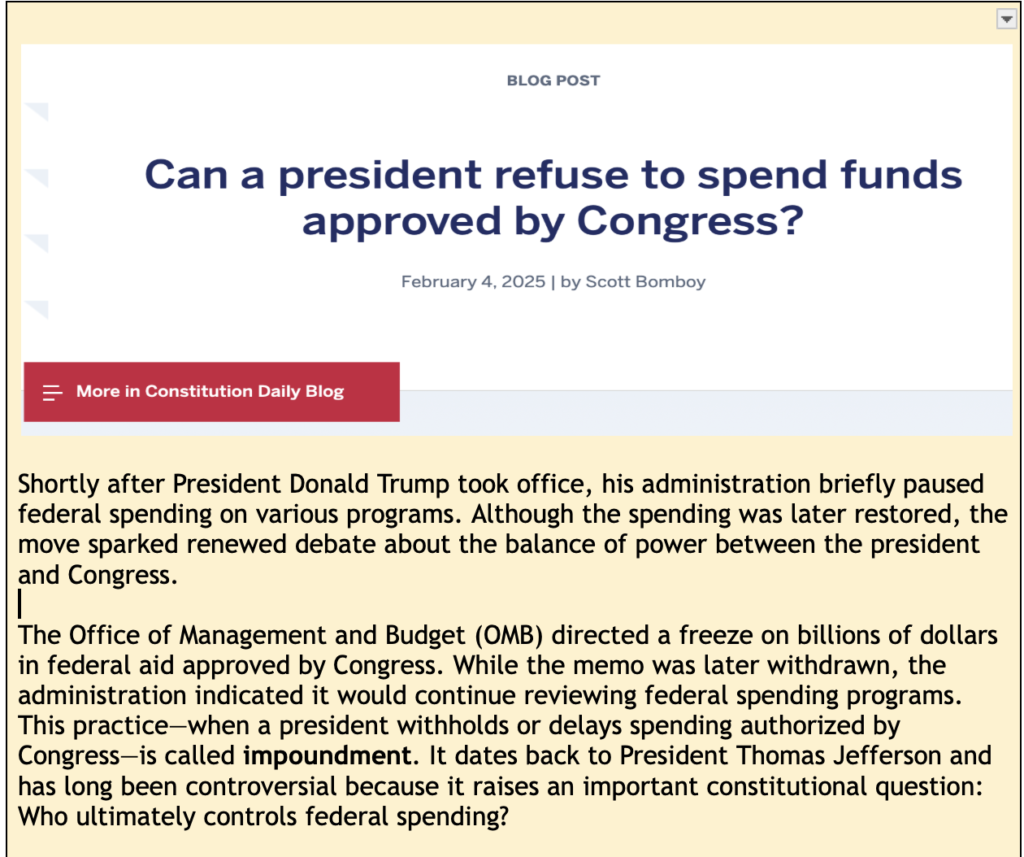
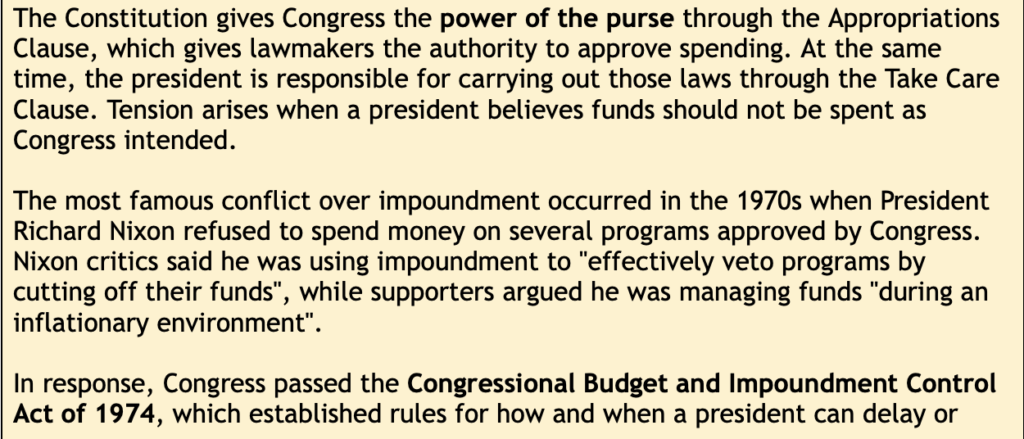
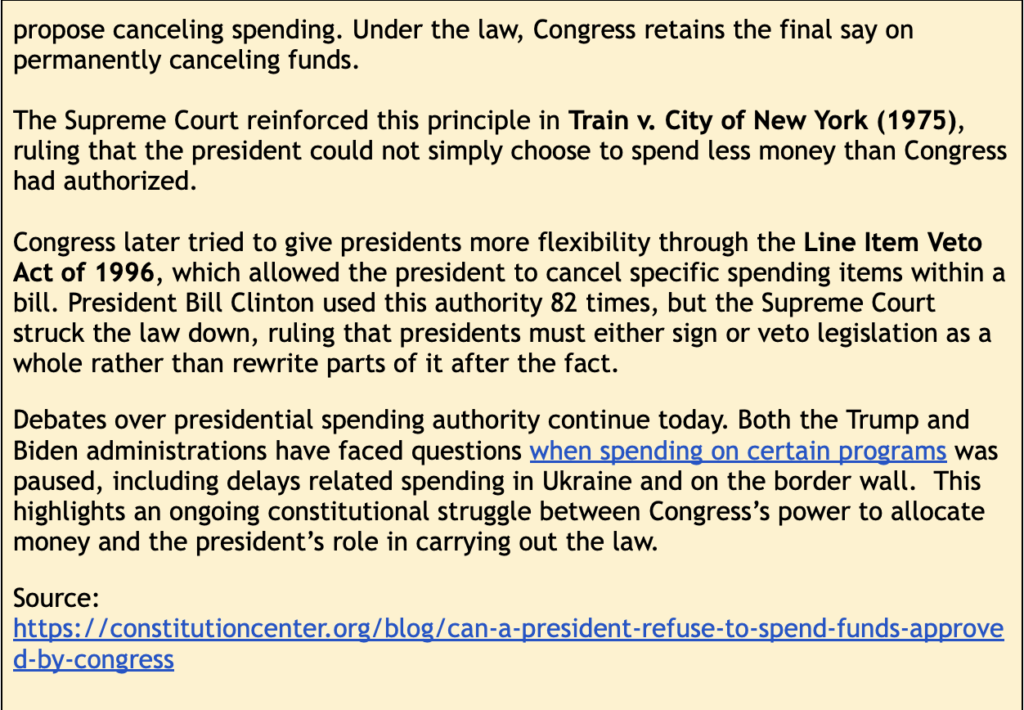
That said, nuance in laws matter. In fact, a recent and recurring debate asked the question: is the President obligated to actually spend the money that Congress allocates? Or can spending be initiated or paused at the President’s discretion? In other words, even though a President doesn’t get to decide unilaterally (on their own) when and where money will be spent, can they decide when it will not be spent? The process in which the president withholds or delays spending on programs authorized by Congress is called impoundment. Read the article below, adapted from The National Constitution Center’s Daily Blog, about this issue:

You will also notice that the President does not have the power to declare war – that power actually resides with Congress. However, numerous presidents have gotten around this and have taken military action without Congressional approval. In fact, the last time that the United States formally declared war was in 1942, during World War II, and it has only declared war 11 times in total. Since 1942, every single U.S. president has used military force without formal declaration of war!
This includes U.S. military actions, and engagement in warfare, such as:
- The War in Afghanistan (2001-2021)
- The War in Iraq (2003-2011)
- The Korean War (1950-1953)
- The Vietnam War (1962-1973)
- The Persian Gulf War (1991)
As we are learning, while there are laws and checks and balances, the actuality often isn’t so straightforward. It is, after all, a human, and thus imperfect and constantly evolving, system.
| Vocabulario Esencial | |
| Vetar | To Veto |
| Conceder Indultos | To Grant Pardons |
| Nombrar | To Appoint |